
 Set as preferred source


The European Union has identified textiles and apparel as one of the first priority product groups for Digital Product Passports (DPPs) under the Ecodesign for Sustainable Products Regulation (ESPR). The direction is already clear: companies placing textile products on the EU market should prepare for new product information and traceability requirements.
The legal framework is established by Regulation (EU) 2024/1781 (ESPR), while the ESPR Working Plan 2025–2030, adopted by the European Commission in April 2025, confirms textiles and apparel as a priority sector for the first wave of product-specific rules.
The detailed requirements will be introduced through a dedicated Delegated Act for Textiles, which is expected to be adopted in 2027. Following the typical ESPR transition period, Digital Product Passport obligations are expected to begin applying from late 2028 or early 2029.
Although the final delegated act has not yet been published, the expected direction is well understood. Textile companies will need to provide structured digital information covering areas such as product identification, fibre composition, manufacturing origin, sustainability characteristics, repairability, and end-of-life guidance.
For many businesses, the challenge will not be creating a Digital Product Passport itself. It will be collecting, managing, and maintaining reliable product and supply chain data across increasingly complex global value chains.
Understanding the Textile DPP
A Digital Product Passport (DPP) for textiles is a digital record that provides standardized information about a textile product throughout its lifecycle.
Accessible through a unique digital identifier, such as a QR code, it enables manufacturers, brands, importers, retailers, consumers, repair services, and recyclers to access product information from a single digital source.
The objective is to create a consistent, reliable, and interoperable source of product information that supports transparency, traceability, and circularity across the textile value chain - from raw material sourcing and manufacturing to resale, repair, and recycling.
Think of the Digital Product Passport for textiles as a "digital fingerprint" for your products. Leveraging a data carrier like a QR code, the DPP will include essential information about a product's supply chain, as well as environmental footprint, details about materials used, chemical compliance data, recyclability, and repairability.
Digital Product Passport vs. Traditional Product Labels
DPP is a digital record that can be accessed through a data carrier, such as a QR code or NFC tag. The passport provides detailed information about a product, including its material composition, manufacturing and supply chain information, environmental characteristics, repairability, recyclability, and other lifecycle data. The QR code will be placed on the physical label of the garment
A traditional product label communicates essential information, such as fibre composition, country of origin, and care instructions.
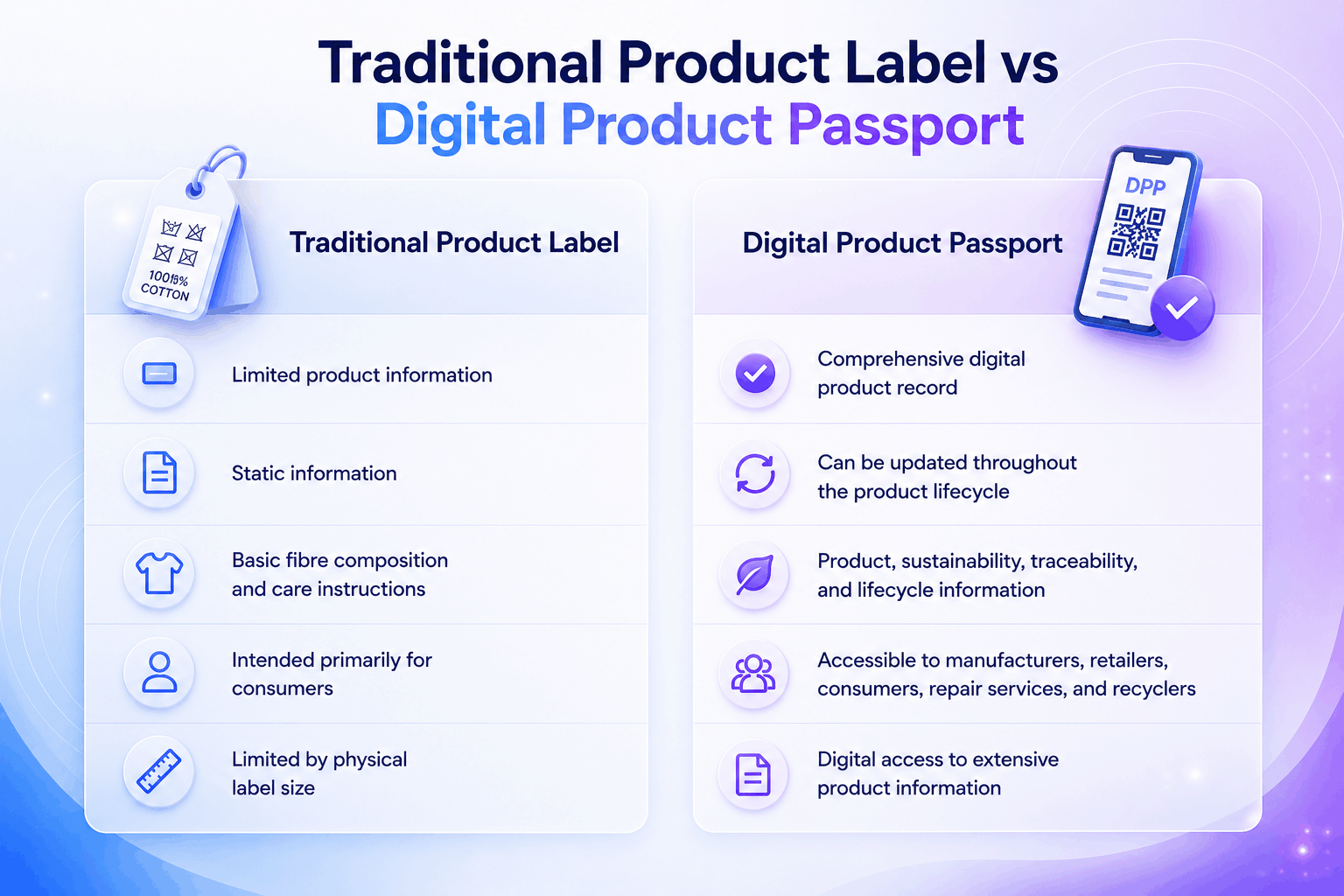
Rather than replacing physical labels, the two are designed to work together. The physical label provides key information that consumers can access immediately, while the QR code links to the Digital Product Passport, where more comprehensive product information is available. The physical label is the consumer-facing summary, the DPP is the deep dive.
Which textile products will be covered?
The final scope of products covered by the Textile Digital Product Passport will be defined in the future Delegated Act for Textiles under the Ecodesign for Sustainable Products Regulation (ESPR).
However, the ESPR Working Plan 2025–2030 identifies textiles (including apparel) as one of the first priority product groups, indicating that the requirements are expected to apply across a broad range of textile and fashion products placed on the EU market.
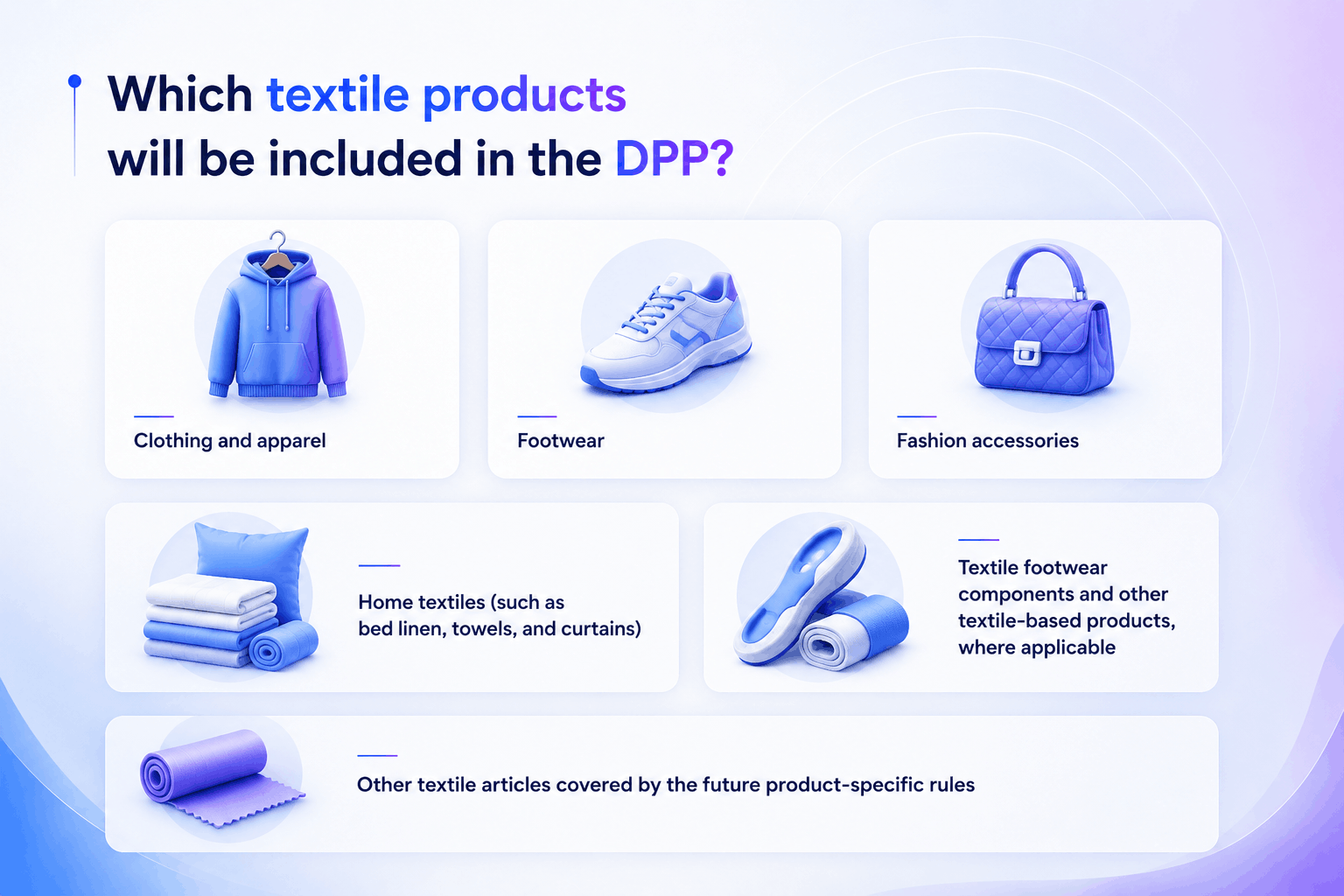
The exact product categories, exemptions, and implementation timeline will be confirmed in the Delegated Act for Textiles once adopted. The European Commission plans to adopt the Delegated Act in 2027.
Which businesses will be affected?
The upcoming requirements are expected to affect businesses across the entire textile and fashion value chain.
Organizations likely to be affected include:
- Textile manufacturers produce fibres, yarns, fabrics, and finished textile products.
- Fashion and apparel brands placing products on the EU market under their own name, regardless of where the products are manufactured.
- Private-label manufacturers producing garments and textile products for third-party brands.
- Importers bringing textile and fashion products into the European Union.
- Distributors, retailers, and e-commerce businesses selling textile products within the EU.
- Repair, resale, rental, and recycling companies that rely on product information to extend product life and support circular business models.
What information will a Textile DPP contain?
The final data requirements for Textile Digital Product Passports will be defined in the future Delegated Act for Textiles. While these requirements have not yet been formally adopted, the European Commission's Joint Research Centre (JRC) has already published a draft study that provides the technical basis for the upcoming legislation.
According to the Joint Research Centre (JRC) draft study, Study on DPP Content for Textile Apparel Products under the Ecodesign for Sustainable Products Regulation (ESPR), the proposed Textile Digital Product Passport could include around 50 data points grouped into four categories: product identification, producer identification, product information, and compliance documentation.
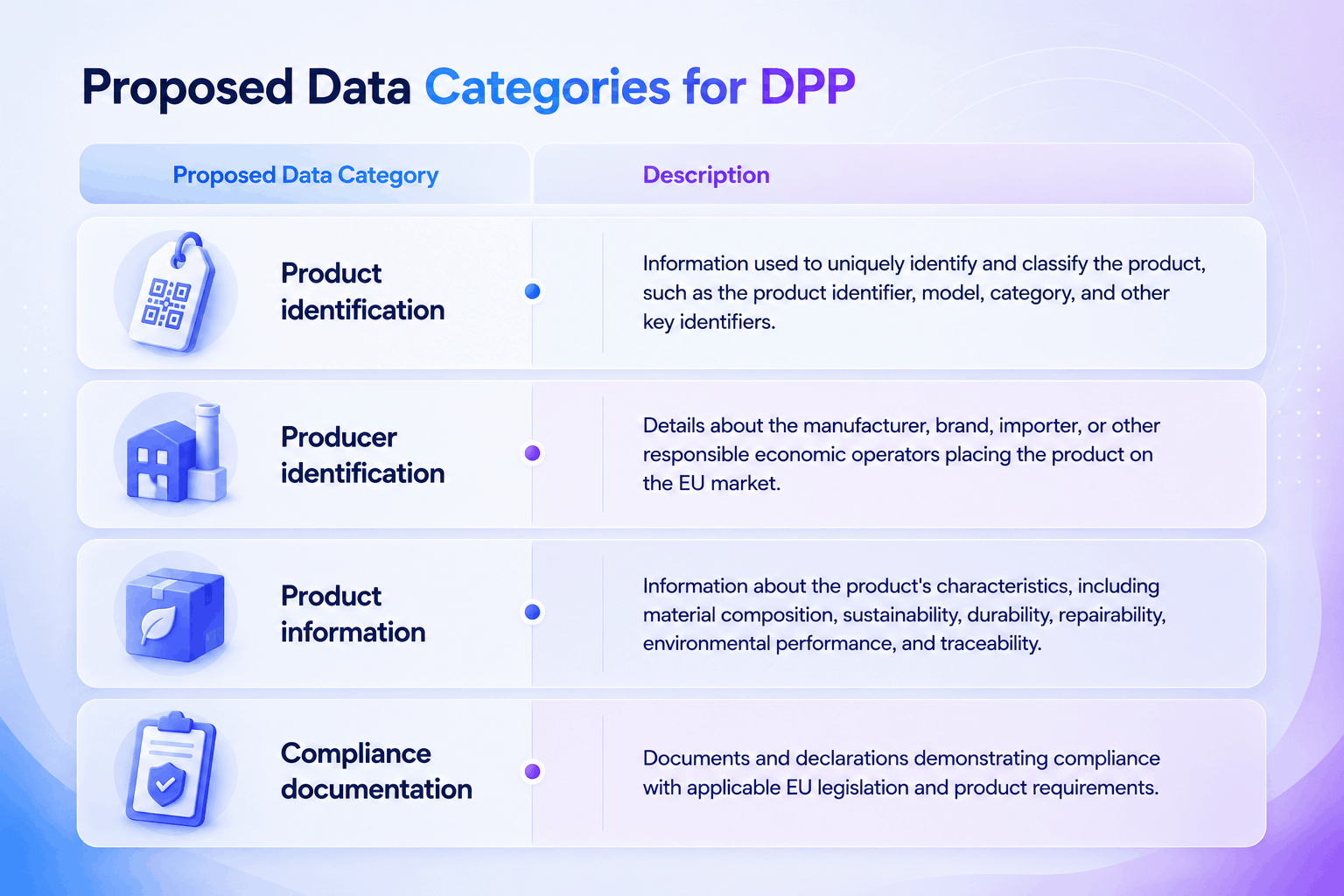
The exact number of required data fields and their structure may change before the Delegated Act is adopted. However, the JRC proposal provides a clear indication of the level of detail businesses should expect.
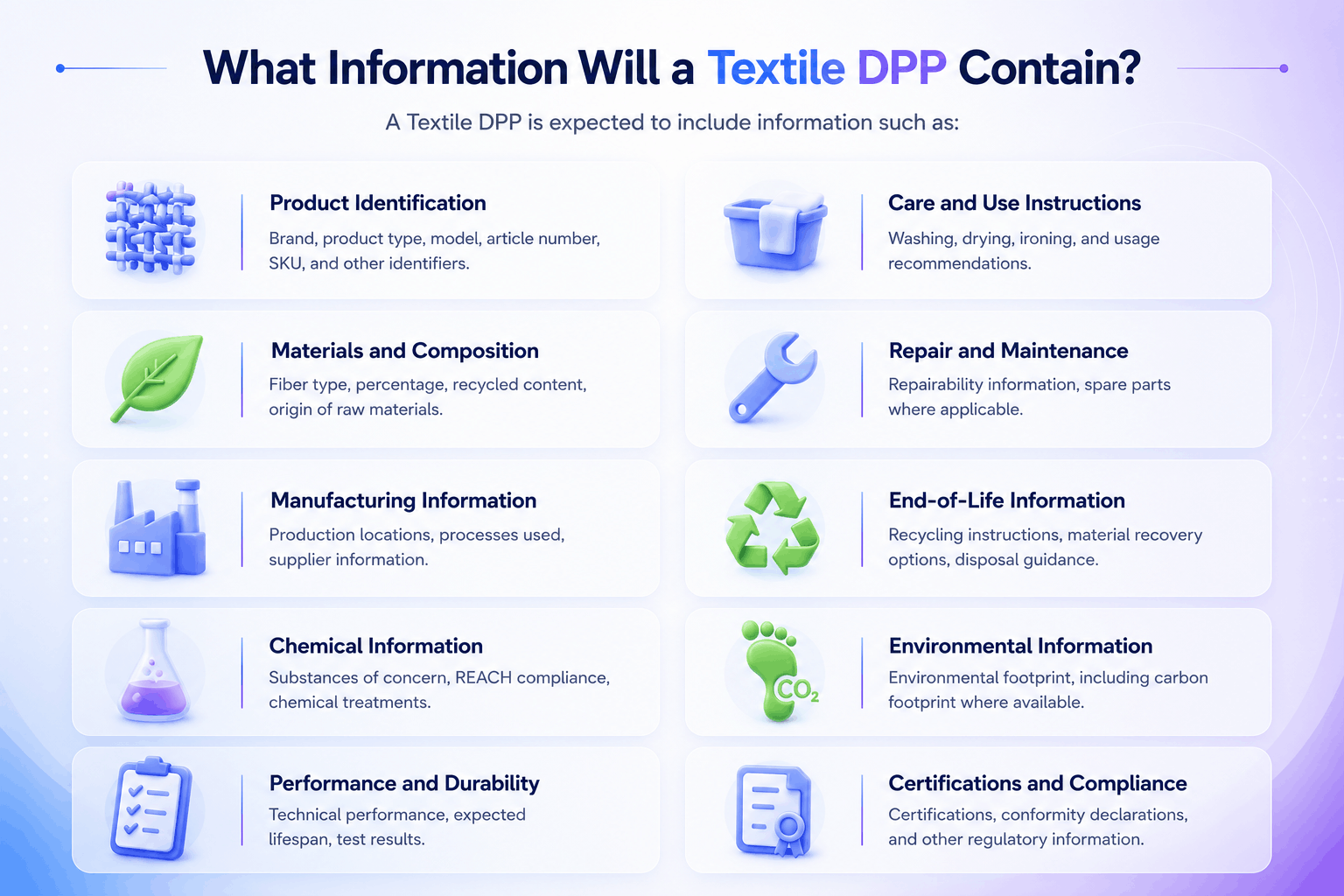
For many textile companies, the challenge will not be collecting a handful of product attributes. It will be managing dozens of interconnected data points originating from suppliers, manufacturers, testing laboratories, sustainability systems, and internal product databases.
The real challenge: managing textile product data
Unlike traditional product labels, a Digital Product Passport relies on information gathered throughout the entire product lifecycle. A single garment may involve raw materials sourced in one country, yarn production in another, fabric manufacturing elsewhere, garment assembly in a different region, and distribution across multiple markets.
As a result, the required information is rarely stored in one place. It is typically distributed across ERP and PLM systems, supplier portals, sustainability platforms, quality management systems, testing laboratories, and spreadsheets owned by different departments and external partners.
Preparing for Digital Product Passports therefore begins with data, not technology. Before businesses can generate a passport, they should:
- Map the required data and identify where it currently resides.
- Assess data quality to identify missing, inconsistent, or outdated information.
- Define data ownership, assigning clear responsibility for creating, validating, and maintaining each category of product information.
- Engage suppliers early, as many required data points will originate outside the organization.
- Integrate business systems to ensure product information remains consistent and can be updated throughout the product lifecycle.
In most organizations, this is a cross-functional effort rather than the responsibility of a single department. Product, sustainability, compliance, procurement, supply chain, and IT teams all play a role in building and maintaining the information required for Digital Product Passports.
Who will be responsible for the DPP?
The final allocation of responsibilities for textile products will be established in the future Delegated Act for Textiles. However, the ESPR framework already indicates that responsibility for making a Digital Product Passport available will generally rest with the economic operator placing the product on the EU market.
Depending on the business model, this may be:
- The manufacturer, when placing products on the EU market under its own name.
- A fashion brand or brand owner, even if manufacturing is outsourced to third-party suppliers.
- The importer, when importing textile products from outside the EU.
- An authorised representative, where applicable under EU product legislation.
Although one economic operator will ultimately be responsible for the Digital Product Passport, the required information will come from multiple participants across the supply chain. Fibre producers, yarn manufacturers, fabric mills, garment manufacturers, testing laboratories, logistics providers, and certification bodies may all contribute data required to complete the passport.
As a result, creating a Digital Product Passport is not simply a compliance task for one company. It is a collaborative process that depends on accurate, standardized, and traceable information being shared across the entire textile value chain.
Questions still awaiting answers
While the ESPR establishes the legal framework for Digital Product Passports, many implementation details for textile products have not yet been finalized. These are expected to be addressed in the future Delegated Act for Textiles and supporting technical standards.
Some of the most important questions businesses are still waiting to have answered include:
- Who will create the Digital Product Passport?
The current expectation is that responsibility will rest with the economic operator placing the product on the EU market. Depending on the business model, this may be the manufacturer, the brand owner, or the importer. However, the exact allocation of responsibilities for textile products has not yet been formally defined.
- Where will the Digital Product Passport be stored?
The ESPR requires product information to be accessible through a unique data carrier, such as a QR code, but it does not prescribe a single EU-wide database. It is expected that Digital Product Passports will be hosted through decentralized digital solutions, although the final technical architecture is still under development.
- Who will generate the QR code?
The legislation requires a data carrier that links users to the Digital Product Passport but does not yet specify who will generate or manage it. This is expected to become part of the implementation framework for each product group.
- Who is responsible for the information?
Although one economic operator is expected to be responsible for making the Digital Product Passport available, the information itself will likely originate from multiple participants across the supply chain, including material suppliers, manufacturers, testing laboratories, and certification bodies.
- Who will be liable for non-compliance?
The ESPR requires Member States to establish effective, proportionate, and dissuasive penalties for non-compliance. However, the specific enforcement mechanisms, responsibilities, and penalties for textile products will be clarified as the product-specific legislation is finalized.
- Who will host and manage Digital Product Passport data?
While the legislation defines what information should be made available, it does not yet specify who will operate the digital infrastructure behind the Digital Product Passport. Questions such as where data will be hosted, who will manage the underlying systems, how long information must remain available, and how interoperability between different platforms will be ensured are still being developed.
Conclusion
The regulatory framework for Textile Digital Product Passports is still evolving, but the preparation window is already shrinking. Over the next two to three years, the remaining technical requirements, implementation rules, and standards are expected to be finalized, leaving businesses with a relatively short period to prepare before compliance becomes mandatory.
For most organizations, the greatest challenge will not be generating a Digital Product Passport. It will be building the data foundation behind it—connecting product information across suppliers, internal systems, and business functions while ensuring that data remains accurate, traceable, and up to date.
Companies that begin this work now will be in a stronger position not only to meet future textile requirements, but also to adapt as Digital Product Passports expand to additional product categories across the European market.
SmithySoft helps companies build the software, integrations, and data infrastructure needed to support product traceability, regulatory compliance, and Digital Product Passport initiatives across complex supply chains.