
 Set as preferred source


From 18 February 2027, batteries used in light means of transport (LMT) such as e-bikes and e-scooters, industrial batteries with a capacity greater than 2 kWh, and electric vehicle batteries placed on the EU market will be required to have an electronic record known as a Battery Passport.
The requirement is established by the EU Battery Regulation (Regulation (EU) 2023/1542). The Battery Passport is intended to make battery information more transparent, traceable, and accessible throughout the battery lifecycle, supporting battery reuse, repurposing, and recycling across the European market.
This article explains what the EU Battery Passport is, who it affects, the key requirements businesses should understand, and how organizations can begin preparing before the 2027 deadline arrives.
What is the EU Battery Passport?
Article 3(72) in the EU Battery Regulation defines a battery passport as:
"a digital record specific to an individual battery that provides access to information concerning the battery model and information specific to the individual battery, including information resulting from the use of the battery and its status."
In practice, a Battery Passport serves as a digital identity for a battery throughout its lifecycle. Through a unique identifier and electronic record, authorized stakeholders can access information about the battery's origin, technical characteristics, composition, carbon footprint, performance, durability, and end-of-life management.
Unlike traditional product documentation, a Battery Passport is designed to accompany a battery from manufacturing through use, reuse, repurposing, and recycling. The information can be updated over time, creating a continuously evolving record that supports transparency and traceability across the battery value chain.
The passport is intended to serve multiple stakeholders. Manufacturers can use it to demonstrate compliance with regulatory requirements. Importers and distributors can verify product information. Battery owners and operators can access performance and maintenance data. Recyclers and second-life operators can better assess a battery's composition and remaining value.
Is a Battery Passport the same as a Digital Product Passport?
Not exactly.
A Battery Passport is a specific type of Digital Product Passport (DPP) introduced under the EU Battery Regulation (Regulation (EU) 2023/1542). While Digital Product Passports are expected to be introduced across a wide range of product categories under the Ecodesign for Sustainable Products Regulation (ESPR), batteries are among the first products for which a digital passport becomes a mandatory legal requirement.
Both concepts share the same objective: improving product transparency, traceability, and circularity throughout the product lifecycle.
The main difference lies in the scope of information. Battery Passports include battery-specific data such as carbon footprint information, battery chemistry, recycled content, performance metrics, and lifecycle information. Future Digital Product Passports for products such as textiles, electronics, furniture, and construction materials will contain different datasets tailored to the characteristics and regulatory requirements of those industries.
For this reason, many policymakers and industry experts view the Battery Passport as one of the first large-scale implementations of the broader Digital Product Passport framework in Europe. The lessons learned from battery passport adoption are likely to influence how Digital Product Passports are implemented across other sectors in the coming years.
Which batteries are covered?
Not all batteries are required to have a Battery Passport.
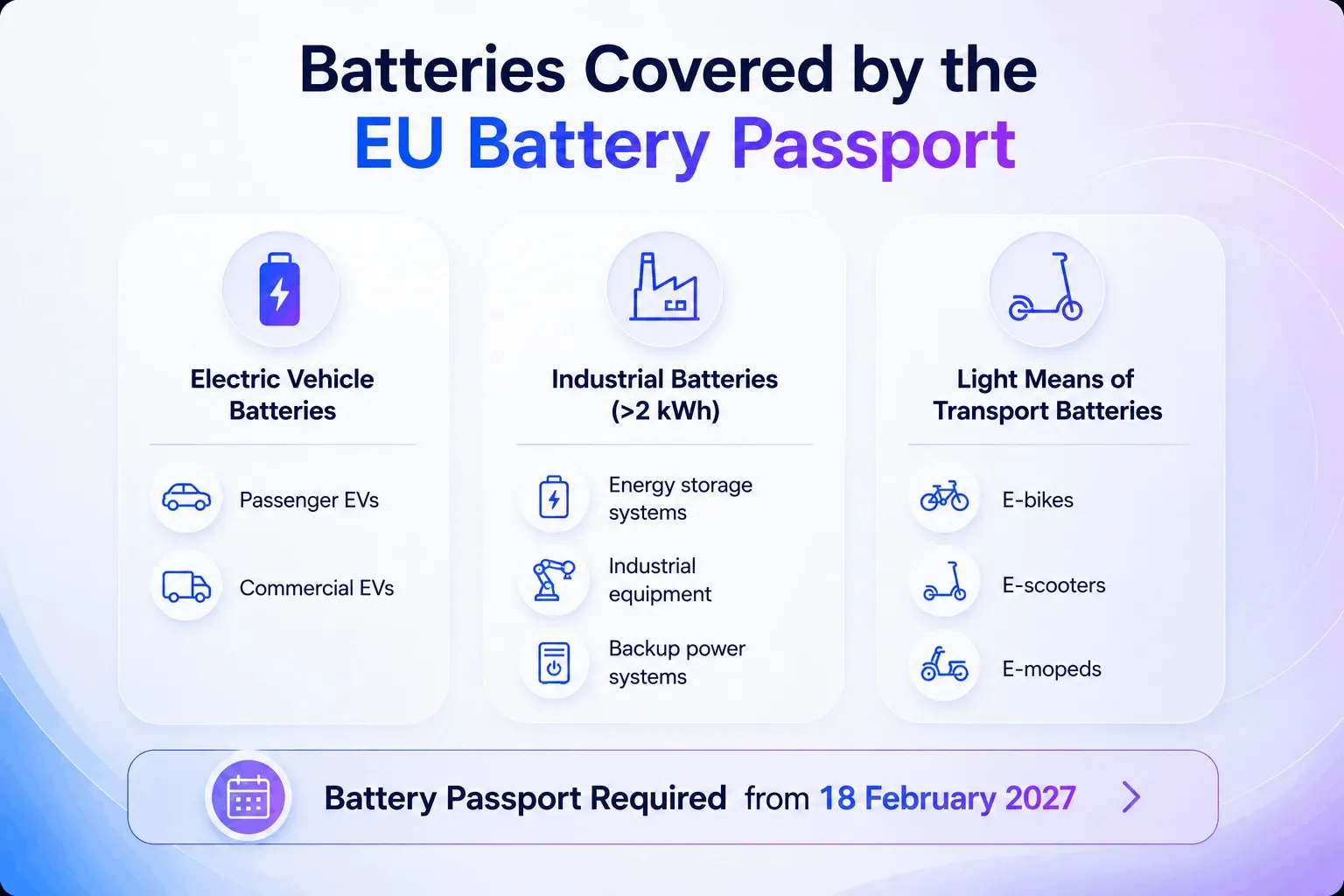
These categories were selected because of their growing economic importance, environmental impact, and role in Europe's transition to clean energy and sustainable mobility.
However, the regulation's impact extends far beyond battery manufacturers. Companies involved in importing, distributing, integrating, servicing, reusing, or recycling covered batteries may also need access to Battery Passport information. As a result, the requirement affects a broad ecosystem of organizations across the battery value chain.
For many businesses, the key question is no longer whether Battery Passports apply to them, but how they will collect, manage, and share the information required to support them.
What about repaired, repurposed, and second-life batteries?
The EU Battery Regulation is designed to support battery traceability throughout the entire lifecycle of a battery - not only when it is first placed on the market.
This is reflected in the Battery Passport definition itself. Article 3(72) of Regulation (EU) 2023/1542 describes the Battery Passport as a digital record that includes information about an individual battery, including information resulting from its use and current status.
The regulation also recognizes activities such as battery repurposing, remanufacturing, and second-life applications. For example, Article 3 defines:
- repurposing as using a battery for a different purpose or application than originally intended;
- remanufacturing as industrial processing that restores a waste battery to a condition suitable for its original purpose;
- preparation for repurposing and preparation for remanufacturing as specific recovery operations.
As batteries move through repair, reuse, repurposing, and recycling processes, access to reliable information about battery composition, performance, state of health, and lifecycle history becomes increasingly important.
For businesses involved in battery refurbishment, second-life energy storage systems, repair services, or recycling operations, Battery Passport data can help assess battery condition, remaining value, and appropriate end-of-life treatment options.
This lifecycle perspective is one of the key differences between a Battery Passport and traditional product documentation. The passport is intended to remain relevant long after a battery leaves the factory.
What information must a Battery Passport contain?
A Battery Passport is accessed through a unique identifier, typically provided via a QR code attached to the battery. The code links to a digital record containing information about the battery throughout its lifecycle.
The purpose of this record is not simply identification. Under the EU Battery Regulation, the Battery Passport is intended to provide standardized information that can be accessed by different stakeholders throughout the battery value chain, including manufacturers, importers, distributors, users, repair operators, and recyclers.
The requirement is established under Articles 77 and 78 of Regulation (EU) 2023/1542, while the information requirements are defined in Annex XIII and related annexes covering carbon footprint, due diligence, performance, durability, and end-of-life management.
Under the EU Battery Regulation, Battery Passports are required to provide information across several key categories, including:
| Information Category | Examples |
|---|---|
| Identification data | Battery model, manufacturer, unique identifier |
| Technical specifications | Capacity, chemistry, performance characteristics |
| Carbon footprint data | Carbon footprint declaration and sustainability information |
| Material composition | Critical raw materials and hazardous substances |
| Recycled content | Recycled cobalt, lithium, nickel, and lead content |
| Due diligence information | Supply chain and sourcing information |
| Performance and durability | State of health, expected lifetime, performance metrics |
| End-of-life information | Reuse, repurposing, collection, and recycling information |
Who will need to comply?
Although Battery Passports are often associated with battery manufacturers, the requirements affect a much broader group of organizations.
Battery manufacturers will be responsible for creating and maintaining Battery Passport information for covered batteries placed on the EU market.
Importers will need to ensure that batteries entering the European market meet regulatory requirements and are accompanied by the required information.
Electric vehicle manufacturers and equipment producers that integrate batteries into their products will need access to Battery Passport data to support compliance, reporting, and product lifecycle management.
Distributors and retailers may need to verify that required battery information is available and accessible throughout the supply chain.
Reuse, repurposing, repair, and recycling operators will rely on Battery Passport data to assess battery condition, composition, remaining value, and end-of-life treatment options.
In practice, compliance depends on collaboration across the entire battery value chain. While responsibility for the passport may begin with the battery manufacturer, the data required to support it often originates from multiple suppliers, systems, and business partners.
The real challenge: managing Battery Passport data
For most businesses, creating a Battery Passport will not be the difficult part. The real challenge is collecting, validating, and maintaining the information required to support it.
A Battery Passport brings together data from multiple sources across the battery lifecycle. Technical specifications may come from engineering teams and product databases. Carbon footprint data may originate from sustainability reporting systems. Information about raw materials and recycled content often depends on suppliers. Performance and durability data may be generated during manufacturing, testing, or operation.
In many organizations, this information is stored across separate systems, including ERP, PLM, MES, sustainability platforms, supplier portals, and spreadsheets. Different teams own different parts of the data, and information is not always standardized or easily accessible.
As a result, Battery Passport compliance is as much a data management challenge as a regulatory one.
Businesses preparing for 2027 should focus on four priorities:
- Identify required data
Map the information required for Battery Passports and determine where it currently resides across the organization and supply chain.
- Assess data quality
Evaluate whether the necessary information is complete, accurate, and consistently maintained. Many organizations discover significant gaps during this stage.
- Establish data ownership
Define who is responsible for collecting, validating, updating, and approving different categories of information.
- Build integration and governance processes
Create processes and technical connections that allow information to flow between systems and remain current throughout the battery lifecycle.
Companies that start this work early will be better positioned to meet regulatory requirements and avoid costly last-minute compliance efforts. More importantly, they will establish a stronger foundation for future Digital Product Passport requirements, which are expected to expand across additional product categories in the coming years.
What happens if businesses fail to comply?
The EU Battery Regulation does not establish a single EU-wide fine for Battery Passport non-compliance. Instead, each Member State is responsible for defining penalties and enforcement measures.
However, the consequences can extend well beyond financial sanctions.
- Restricted access to the EU market
The most significant risk is the inability to place affected batteries on the EU market. If a battery subject to the Battery Passport requirement does not meet regulatory obligations, market surveillance authorities may restrict or prohibit its sale.
2. Regulatory enforcement actions
National authorities may request documentation, investigate compliance, require corrective actions, or order the withdrawal of non-compliant products from the market.
3. Supply chain and commercial risks
Battery Passport compliance is likely to become a requirement throughout the supply chain. Manufacturers, importers, vehicle producers, and large buyers may require proof of compliance from their suppliers. Businesses that cannot provide the necessary information may face delays, lost contracts, or exclusion from procurement processes.
4. Reputational impact
As sustainability and traceability become increasingly important, non-compliance may also create reputational risks with customers, partners, investors, and regulators.
For many organizations, the greatest risk is not a regulatory fine. It is losing access to markets, customers, and supply chain relationships that depend on Battery Passport compliance.
How can businesses prepare for 2027?
Although the Battery Passport requirement takes effect in February 2027, preparation should begin well before the deadline. Building a compliant Battery Passport is not a one-time exercise - it requires processes, data governance, and coordination across multiple systems and business partners.
One of the first challenges organizations face is determining who should lead the initiative. Because Battery Passport data spans multiple departments - including engineering, manufacturing, procurement, sustainability, compliance, IT, and supply chain management - successful projects typically require a cross-functional approach.
In many organizations, the initiative is coordinated by a compliance, sustainability, or product stewardship team, while IT and data management teams support the technical infrastructure needed to collect, integrate, and maintain information. Regardless of the organizational structure, a clear project owner should be appointed to coordinate stakeholders, define responsibilities, and oversee implementation.
Businesses can start by:
- Identifying which batteries fall within scope of the regulation.
- Mapping required data sources across internal systems and suppliers.
- Assessing data quality and completeness to identify gaps.
- Establishing data ownership and governance processes.
- Evaluating technology infrastructure needed to manage, exchange, and update Battery Passport information.
- Engaging suppliers early to ensure access to the information required by the regulation.
Organizations that begin this process early will have more time to address data gaps, improve traceability, and integrate information across the battery lifecycle.
Conclusion
The Battery Passport is one of the first large-scale examples of how the European Union is turning sustainability and traceability requirements into digital infrastructure.
For businesses, the biggest challenge will not be creating the passport itself, but building a reliable system for collecting, managing, and sharing product and supply chain data throughout the battery lifecycle.
Companies that start preparing early will be better positioned not only for Battery Passport compliance in 2027, but also for the broader rollout of Digital Product Passports across other industries in the years ahead.
SmithySoft helps companies build the software, integrations, and data infrastructure needed to support traceability, compliance, and Digital Product Passport initiatives across complex supply chains.