
 Set as preferred source


The construction industry is entering one of its biggest regulatory changes in decades. Under the new Construction Products Regulation (EU) 2024/3110, many construction products placed on the EU market will gradually require a Digital Product Passport (DPP).
Whether it's cement, concrete blocks, steel beams, insulation, plasterboard, bricks, roof tiles, pipes, cables, windows, doors, flooring, or fastening systems, product information is moving beyond CE marking and technical datasheets toward structured digital records designed to support transparency, sustainability, and circular construction throughout a product's lifecycle.
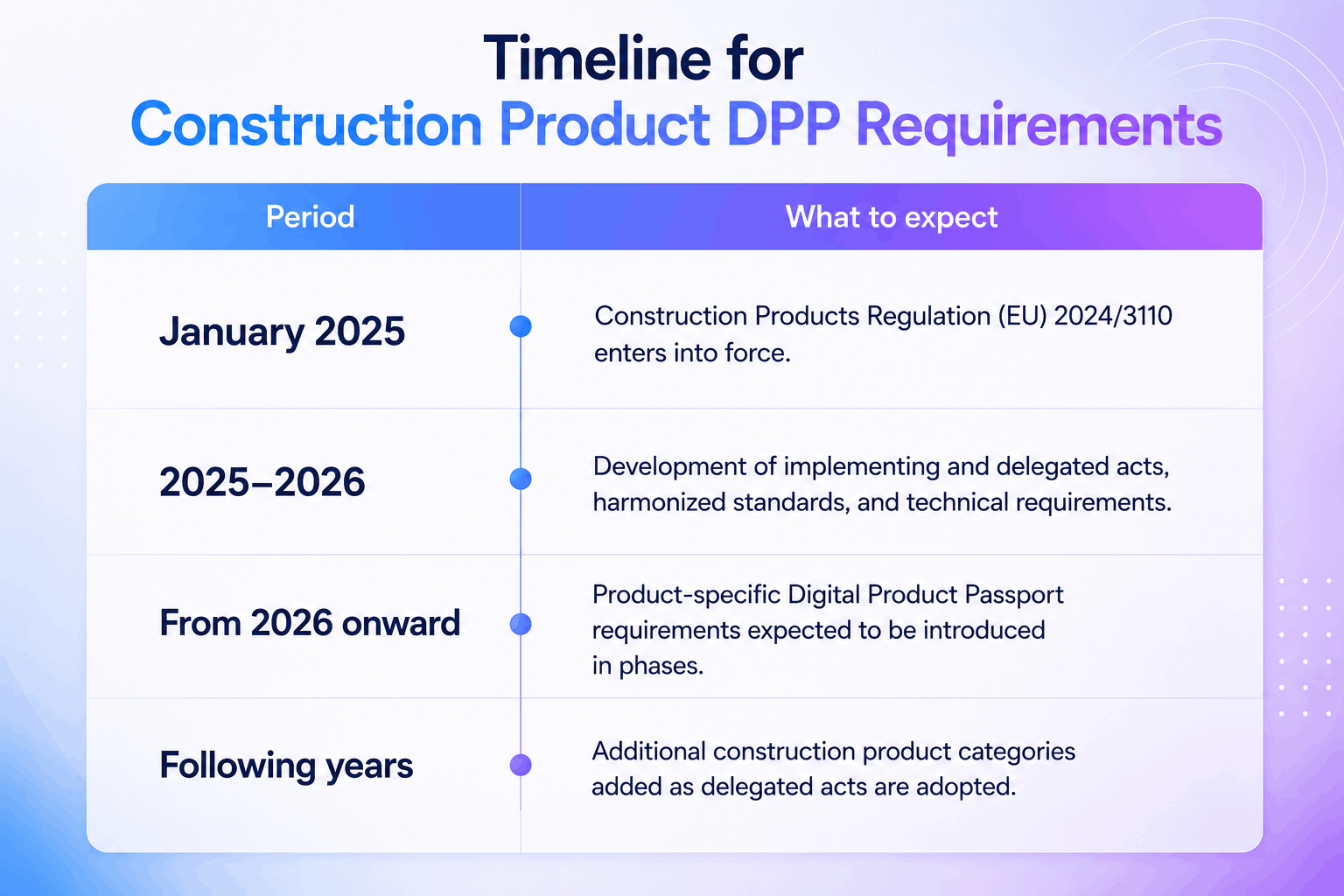
The new requirements will not apply to every product at once. Instead, the European Commission will introduce them progressively through delegated acts, defining which product groups must carry a Digital Product Passport, what information it must contain, and when compliance becomes mandatory.
So, what exactly is changing, which construction products will be affected, and what should manufacturers, importers, and distributors do now? Let's break it down.
What is a Digital Product Passport for Construction Products?
The Digital Product Passport (DPP) is a standardized digital record that provides structured information about a product throughout its lifecycle. It is one of the European Union's key initiatives to improve product transparency, support the circular economy, and make sustainability information more accessible to businesses, regulators, and consumers.
The overall Digital Product Passport framework was introduced through the Ecodesign for Sustainable Products Regulation (ESPR), which establishes common principles for Digital Product Passports across a wide range of products sold in the EU.
However, construction products are governed by their own sector-specific legislation. The revised Construction Products Regulation (EU) 2024/3110 (CPR) incorporates the Digital Product Passport concept into the construction sector and provides the legal basis for its future implementation through delegated acts.
For construction products, a Digital Product Passport will bring together information that is often scattered across technical datasheets, Declarations of Performance (DoP), environmental declarations (EPDs), certificates, installation manuals, and other documentation.
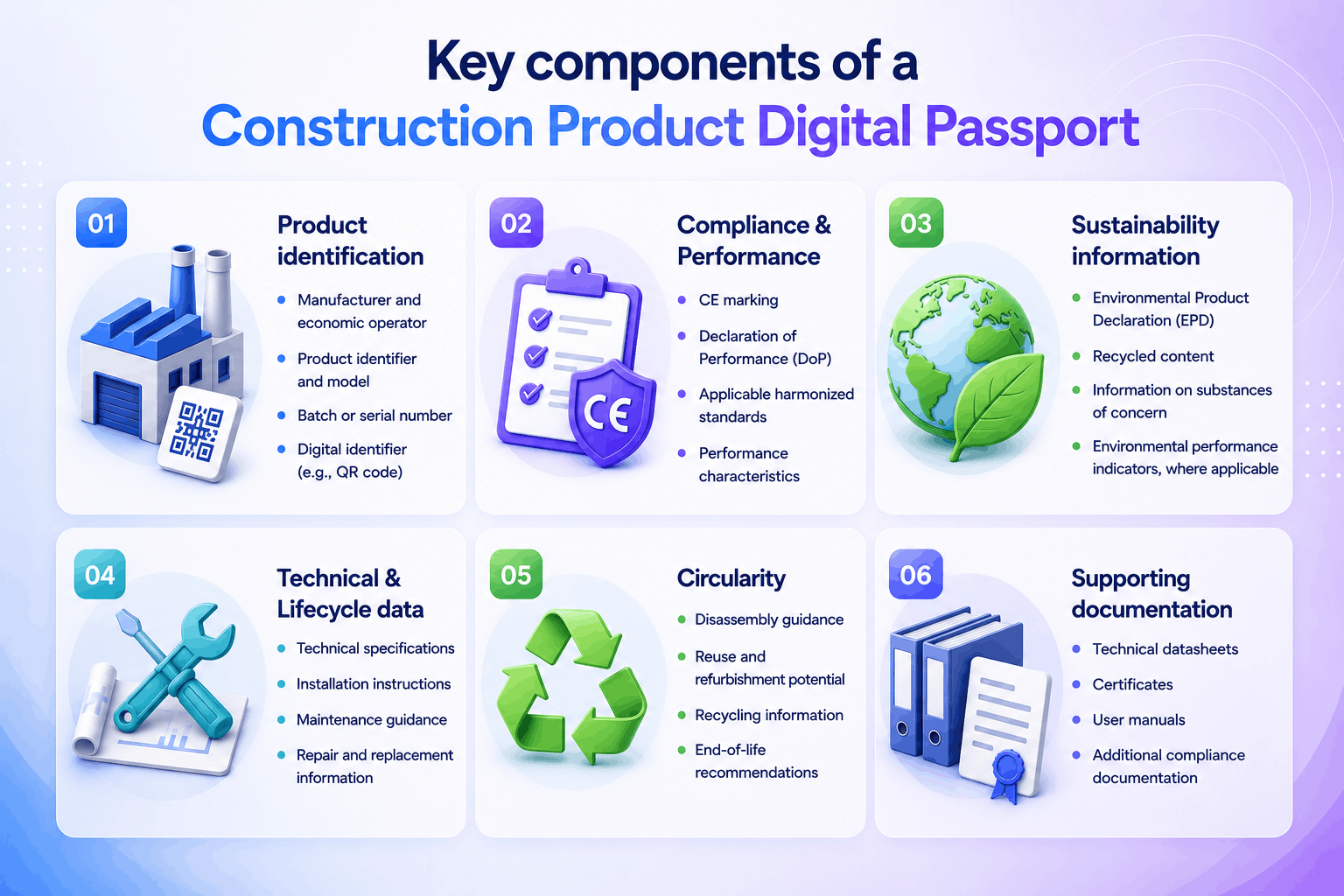
Depending on the product category and future regulatory requirements, a construction Product Passport may include information such as:
- product identification and manufacturer details;
- technical specifications and performance characteristics;
- CE marking and regulatory compliance;
- environmental and sustainability information;
- recycled and hazardous material content;
- installation, maintenance, and repair guidance;
- disassembly, reuse, and recycling instructions;
- links to declarations, certificates, and other supporting documentation.
DPP vs Traditional construction documentation
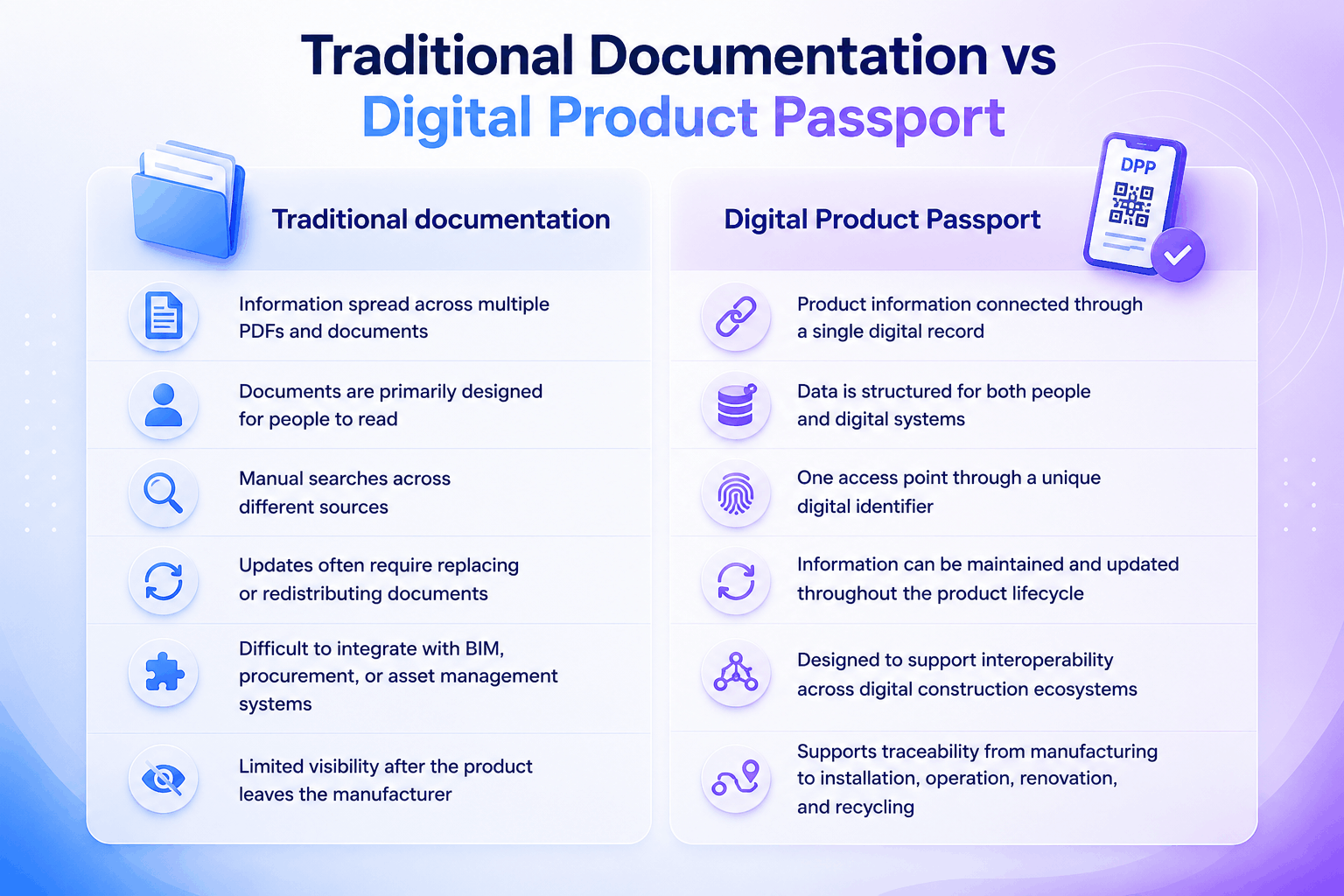
For most construction products, the required information already exists. The difference is not what information is available, but how it is managed.
The Digital Product Passport does not introduce entirely new product information. Instead, it changes how that information is organized, maintained, and shared. Rather than relying on separate technical datasheets, certificates, declarations, and manuals, the DPP connects them through a single standardized digital record.
Which Construction Products will be covered?
Before looking at which products will require a Digital Product Passport, it is important to understand what qualifies as a construction product under the Construction Products Regulation (CPR).
According to Regulation (EU) 2024/3110, a construction product is any product or kit that is manufactured and placed on the market for permanent incorporation into construction works, including buildings and civil engineering infrastructure.
In other words, if a product is intended to become a permanent part of a structure and its performance affects the performance of that structure, it is generally considered a construction product.
This covers a far broader range of products than many businesses expect. Depending on future delegated acts, Digital Product Passport requirements may apply to product categories such as:
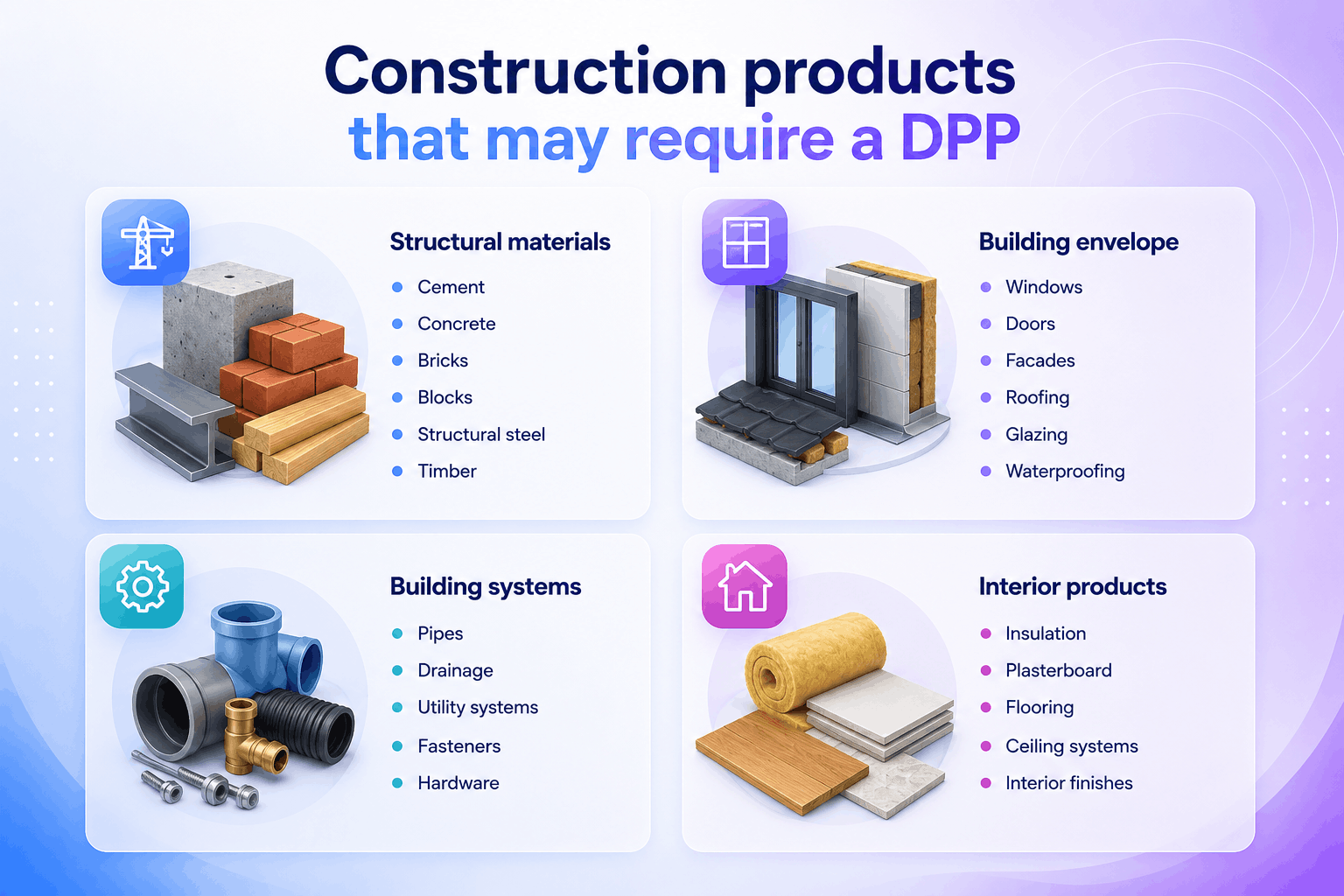
The scope will expand by product group rather than through a single requirement covering the entire construction market at once.
Implementation timeline for Construction Product DPPs
Unlike some other EU regulations, the Construction Products Regulation does not introduce a single implementation date for all construction products. Instead, Digital Product Passport requirements will be introduced gradually through delegated acts adopted by the European Commission.
Each delegated act will specify:
- the product groups covered;
- the information required in the passport;
- technical specifications and data standards;
- transition periods before compliance becomes mandatory.
What data will a Construction Product DPP contain?
The final content of a Digital Product Passport will vary depending on the product category and future delegated acts. However, the Construction Products Regulation provides a clear direction: the passport will bring together the information needed to identify, verify, use, and manage a construction product throughout its lifecycle.
Rather than introducing entirely new documentation, the Digital Product Passport is expected to consolidate information that is currently distributed across declarations, technical documentation, certificates, and environmental reports into a structured digital record.
Who is responsible?
Responsibility for the Digital Product Passport goes beyond generating a QR code or uploading technical documents. The relevant economic operator must ensure that product information is accurate, complete, accessible, and updated when necessary.
The exact obligations will depend on future delegated acts and the role each company plays in the supply chain.
Manufacturers
Manufacturers will usually carry the primary responsibility for creating and maintaining the Digital Product Passport. They will need to connect the passport to the correct product identifier and ensure that the information reflects the product placed on the EU market.
This includes validating technical, performance, compliance, and environmental data before it becomes accessible through the passport.
Authorized representatives
An authorized representative may carry out specific compliance tasks on behalf of a manufacturer established outside the EU. The scope of this responsibility will depend on the written mandate provided by the manufacturer and the applicable product-specific requirements.
However, appointing a representative does not remove the manufacturer's underlying responsibility for the accuracy of product information.
Importers
Importers will need to verify that products entering the EU market meet the applicable requirements. Where a Digital Product Passport is mandatory, this is likely to include checking that the passport exists, contains the required information, and remains accessible through the appropriate product identifier.
This makes data availability an important part of supplier due diligence, particularly when products are sourced from outside the EU.
Distributors
Distributors will need to ensure that the products they make available on the market continue to meet applicable documentation and traceability requirements. They should not remove, obscure, or disrupt access to the product identifier linked to the passport.
Their role is therefore less about creating product data and more about preserving its accessibility and integrity across distribution channels.
Suppliers and data providers
Although suppliers may not always be directly responsible for the final passport, manufacturers will depend on them for material composition, component, environmental, test, and certification data.
Testing laboratories, certification bodies, and environmental data providers may also contribute information used in the passport. The reliability of the final record will therefore depend on how effectively data is collected and validated across the wider supply chain.
In practice, legal responsibility may sit with one economic operator, but the required data will often be distributed across suppliers, compliance teams, laboratories, product databases, ERP systems, and technical documentation.
For construction product companies, DPP readiness is therefore not only a regulatory task. It requires clear data ownership, defined update processes, and coordination between the systems and organizations that produce product information.
How does the DPP relate to CE marking and the Declaration of Performance?
One of the most common misconceptions is that the Digital Product Passport will replace CE marking or the Declaration of Performance (DoP). Under the Construction Products Regulation, this is not the case.
CE marking remains the visible indication that a construction product complies with applicable EU requirements and can be placed on the EU market. The Declaration of Performance (DoP) continues to provide information about a product's declared performance against the relevant harmonized technical specifications.
The Digital Product Passport serves a different purpose. Rather than replacing existing compliance documents, it provides a standardized digital framework for accessing and managing product information throughout its lifecycle. Depending on future delegated acts, the passport may reference or incorporate information that is currently distributed across declarations, technical documentation, certificates, and environmental reports.
In other words, CE marking demonstrates compliance, the Declaration of Performance describes product performance, and the Digital Product Passport connects this information into a single digital ecosystem. Together, they support greater transparency, traceability, and consistency across the construction product supply chain.
How can companies prepare?
Companies do not need to wait for the final delegated acts before taking action. Based on the current regulatory direction, we recommend focusing on the following areas to prepare for Digital Product Passport implementation.
1. Assess existing product information
The first step is to understand what product information already exists and where it is stored. Technical specifications, Declarations of Performance, Environmental Product Declarations, certificates, installation manuals, and test reports are often maintained across multiple departments and systems. Identifying gaps and duplicate information early will simplify future compliance.
2. Establish clear data ownership
A Digital Product Passport requires information that remains accurate throughout the product lifecycle. This makes clear ownership essential. Companies should define who is responsible for maintaining technical, compliance, environmental, and commercial product data, as well as how updates will be reviewed and approved.
3. Strengthen product data management
For many manufacturers, the biggest challenge will not be generating a passport but managing consistent product data across ERP, PIM, PLM, BIM, document management, and compliance systems. Improving interoperability between these platforms can significantly reduce future implementation effort.
4. Work closely with suppliers
Many of the data elements required for a Digital Product Passport originate outside the organization. Material composition, environmental information, testing results, and certification data often come from suppliers and external partners. Establishing consistent data exchange processes early will help avoid bottlenecks as requirements expand.
5. Monitor regulatory developments
The scope, timelines, and data requirements for Digital Product Passports will continue to evolve through delegated acts under the Construction Products Regulation. Companies should regularly monitor updates from the European Commission and industry associations to understand when specific product groups become subject to new obligations.
6. Start with a pilot product range
Rather than waiting until Digital Product Passports become mandatory across multiple product categories, organizations can begin by preparing a limited product portfolio. A pilot project helps validate data quality, identify process gaps, and build internal expertise before wider implementation.
Ultimately, preparing for Digital Product Passports is not simply a compliance project. It is an opportunity to build a stronger product data foundation that supports regulatory compliance, digital collaboration, and greater transparency across the construction product lifecycle.
Why this matters?
Digital Product Passports are not simply another compliance requirement—they address one of the construction industry's longstanding challenges: product information is fragmented, difficult to verify, and rarely travels with the product throughout its lifecycle.
Today, technical specifications, Declarations of Performance, environmental data, certificates, and maintenance instructions are often stored in separate documents and systems. As products move from manufacturers to distributors, contractors, and building owners, information is frequently duplicated, lost, or becomes outdated.
Digital Product Passports establish a single, standardized source of product information that remains accessible throughout the product lifecycle. This makes it easier to verify compliance, demonstrate product performance, conduct lifecycle assessments, support reuse and recycling, and exchange reliable information across the construction supply chain.
In the long term, the value extends beyond regulatory compliance. As construction becomes increasingly digital, organizations will rely on structured product data to support BIM, asset management, sustainability reporting, and future digital building regulations. The Digital Product Passport provides the common data foundation that makes these processes possible.
Conclusion
The biggest challenge of Digital Product Passports is not generating another compliance document – it's creating a reliable digital product data ecosystem. For many manufacturers, the real work lies in consolidating information scattered across ERP systems, technical documentation, supplier records, certificates, and environmental declarations into a single, structured, and interoperable source of truth.
At SmithySoft, we help manufacturers and industrial businesses build this foundation through custom software development, product data management solutions, enterprise system integrations, legacy software modernization, and AI-powered automation. By connecting fragmented data and digital workflows, we help organizations prepare not only for Digital Product Passport implementation but also for the broader digital transformation of the construction industry.
Explore our expert guides on Digital Product Passports and related EU regulations: