
 Set as preferred source


For furniture manufacturers, the EU Digital Product Passport signals a shift from product documentation to product data as part of market access. Once furniture-specific rules apply, covered products will need a passport built on structured, traceable and maintainable data – not simply a label or QR code.
Furniture matters now because the rulemaking process has already started. It is an official ESPR priority product group, the dedicated preparatory study began in March 2026, and the Commission currently targets 2028 for adoption of the furniture delegated act.
At the same time, the wider DPP infrastructure is already moving into operation: the EU Registry is live, and standards for identifiers, data carriers, APIs and interoperability are being established.
What is still missing is the final furniture specification. The exact product scope, required fields, passport level and application date remain open. The real question today is whether manufacturers have the product data foundation that a future DPP will require.
What is actually happening with furniture regulation now
Furniture is not a marginal product category in the ESPR agenda. In the JRC prioritisation, furniture ranked second among priority final-product groups, reflecting its market relevance and potential for improvements in resource and material efficiency.
The furniture DPP is still in the rule-development stage. The regulatory path currently looks like this:
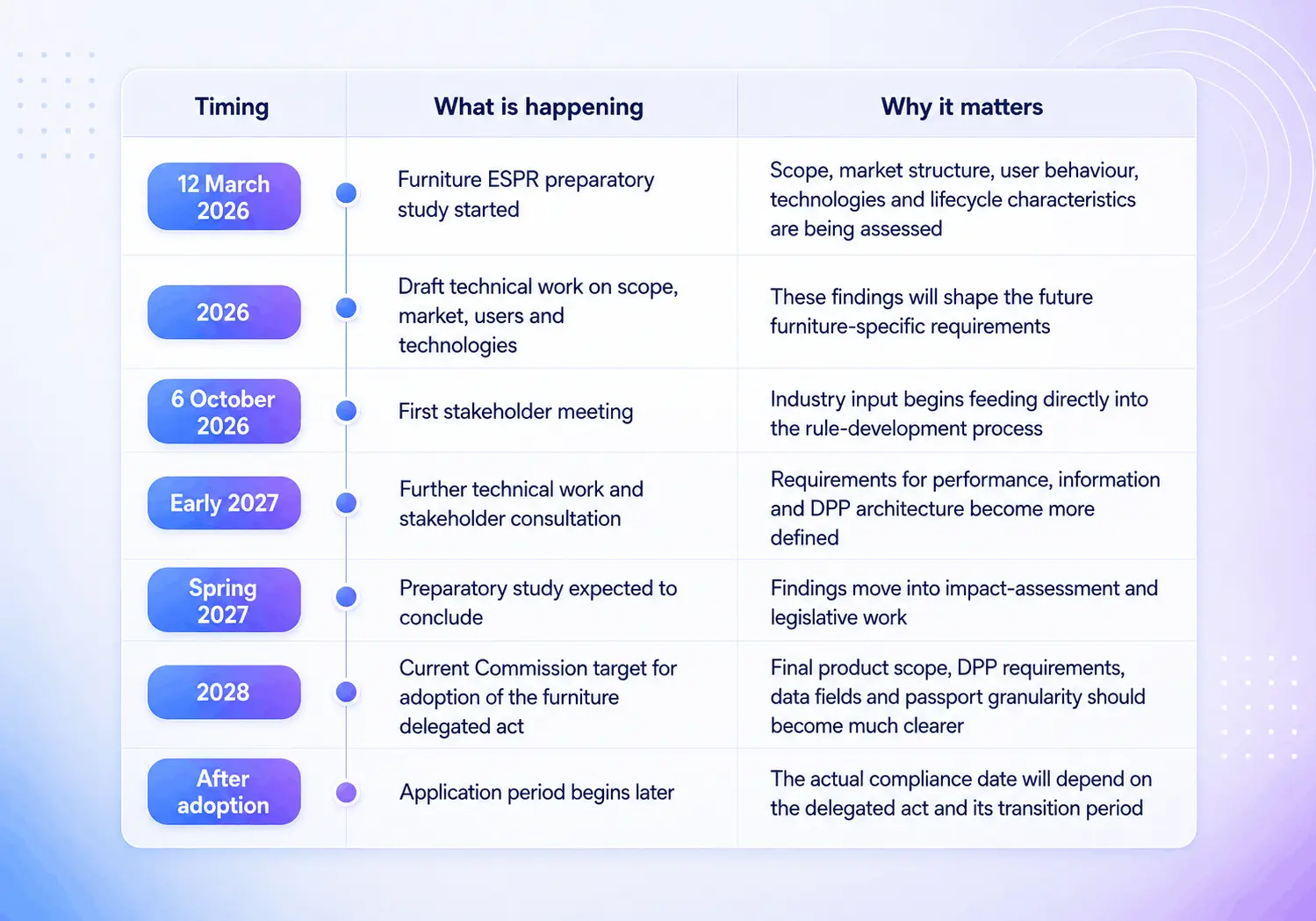
The key distinction is simple: 2028 is currently an adoption target, not a furniture DPP compliance deadline. Under ESPR, application normally cannot start earlier than 18 months after a delegated act enters into force, unless a justified exception applies.
What matters now is that furniture has moved from broad ESPR policy into product-specific rulemaking. The next stage will determine exactly which products are covered, what information must be provided, and how that data will need to be structured and maintained.
One important distinction: the DPP will be only one part of the future furniture rules. Under ESPR, product-specific delegated acts can also introduce performance and information requirements related to durability, repairability, resource efficiency, recycled content, substances of concern and recyclability. Which of these will ultimately apply to furniture is still being determined.
What is already decided – and what is still open
The key issue now is separating the horizontal DPP rules that are already fixed from the furniture-specific choices that remain unresolved. This is where much of the market confusion begins: the technical framework is increasingly defined, while the actual furniture requirements are not.
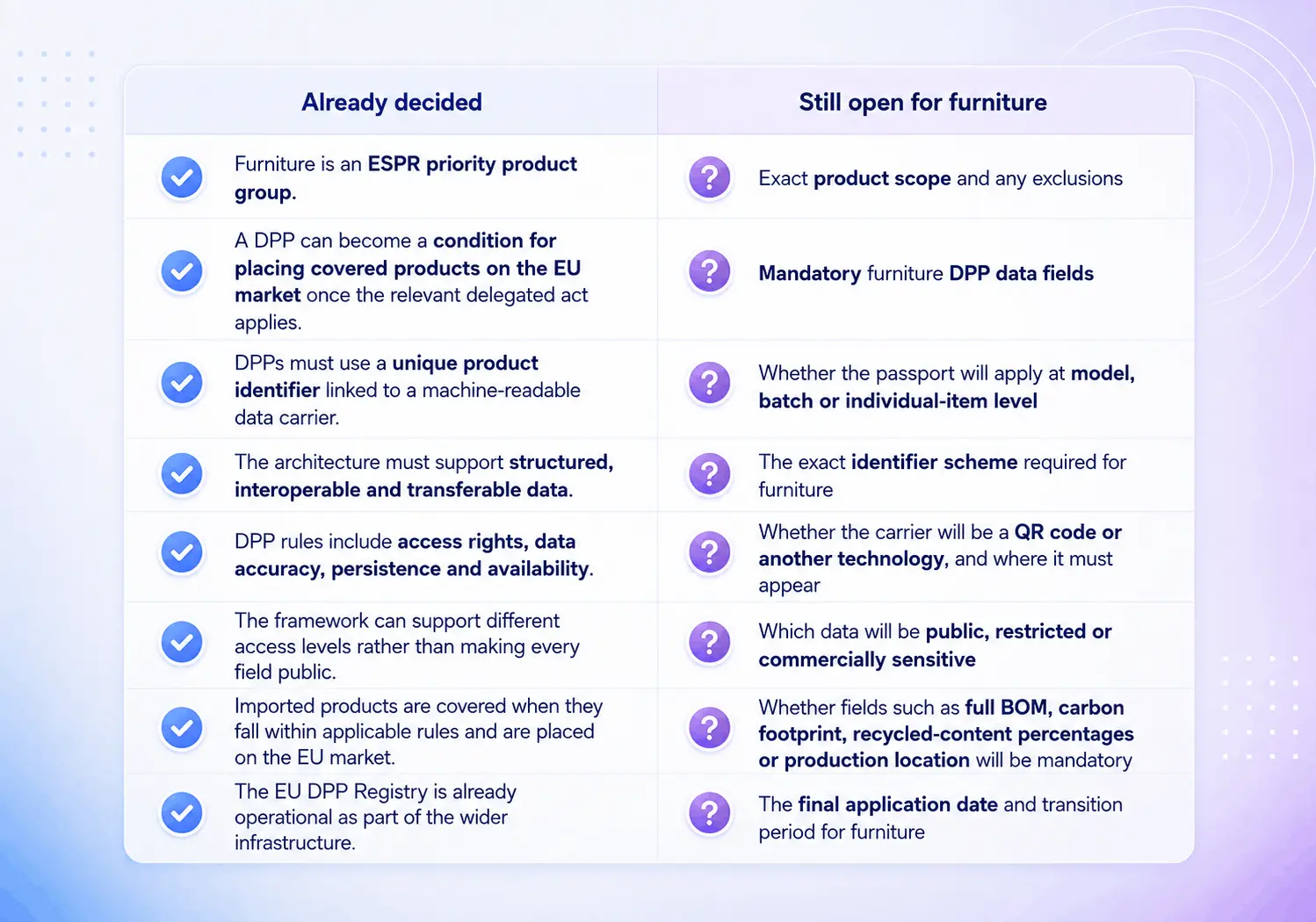
This is why claims such as “every chair will need a QR code in 2028” or “the furniture DPP will require a full BOM and carbon footprint” go beyond what has actually been adopted.
What can be stated with confidence is more limited, but more useful: the technical direction is increasingly clear; the furniture-specific specification is not. Manufacturers can already improve data structure, identifiers and traceability without locking systems to requirements the EU has not yet finalized.
Why furniture is a difficult DPP category
Furniture is a difficult DPP category because the product itself is often a bundle of materials, components, suppliers and variants, not a single standardized object. A chair may combine metal, plastics, foam, textiles, adhesives, coatings and fasteners, each with its own supplier documentation and compliance evidence. The same commercial model can also exist in dozens or hundreds of configurations.
The industry structure compounds that complexity. The European furniture sector includes roughly 1 million workers and around 130,000 companies, with more than 85% of businesses classified as micro-enterprises in industry estimates. EFIC has already highlighted product diversity, fragmented global supply chains, data availability and interoperability between IT systems as central implementation concerns for future ESPR requirements.
The difficulty becomes more visible when products change. A manufacturer can switch a fabric, coating or component supplier without changing the commercial SKU. The finished product may look identical, while its material composition, substance information, certification or recycled-content evidence has changed. If those changes are recorded in separate systems – or only in supplier PDFs – the product record quickly stops being a reliable source of truth.
That is why furniture DPP implementation is less a labeling problem than a product-information problem. The future passport will depend on being able to connect a specific product or version to the right materials, suppliers and evidence, and to keep that relationship accurate as the product evolves.
Furniture may follow a different DPP logic
The furniture DPP should not be assumed to copy the data priorities emerging in batteries or textiles. Current furniture-specific work is placing particular attention on reliability, maintenance, repair, longer product life, material efficiency and recyclability.
EFIC has also cautioned against treating product-level carbon or environmental footprints as an obvious core requirement for furniture, pointing to diverse materials, complex global supply chains, methodology gaps and the potential burden on smaller manufacturers.
This is industry input, not a final Commission decision, but it is an important signal: furniture-specific requirements may develop around the sector’s own lifecycle and circularity challenges rather than simply replicating another product category.
The QR code is the easy part
Take a typical office chair. It may combine a metal frame, plastic components, foam, fabric or leather, adhesives, coatings, wheels and fasteners — often sourced from different suppliers. The commercial SKU may remain unchanged even when one of those inputs changes.
Now assume the fabric supplier is replaced. The chair still looks the same, but the underlying record may not be. Material composition can change. Supplier declarations may need to be replaced. Substances information, recycled-content evidence or certification may also differ.
That is where the real DPP problem begins.
The critical questions are not where to place the carrier or how to generate a QR code. They are:
- Which product version has changed?
- Which supplier evidence belongs to that version?
- Which data fields need to be updated?
- Who owns the update?
- Can the change propagate across the systems that feed the passport?
The visible passport is only the final interface. The harder task is keeping the data behind it accurate as products, materials and suppliers change over time.
Where the DPP data already lives
The data a future furniture DPP may need already lives across ERP, PLM/BOM, PIM, CAD, compliance systems, supplier files and regulatory processes. The problem is that these sources rarely function as one reliable product record.
ERP may hold SKUs, suppliers, purchasing and production data. PLM/BOM contains components, materials and revisions. PIM manages variants and commercial attributes. CAD reflects product structure. Compliance and quality systems hold certificates, declarations and test reports. REACH processes may already contain substances information, while EUDR can add origin and due-diligence data for some wooden furniture.
The gap is in the links between them. A certificate may exist but not be tied to the exact model version. Supplier evidence may sit only in PDFs or email. A component change may appear in purchasing before it reaches the product specification. Different systems may also hold conflicting versions of the same attribute.
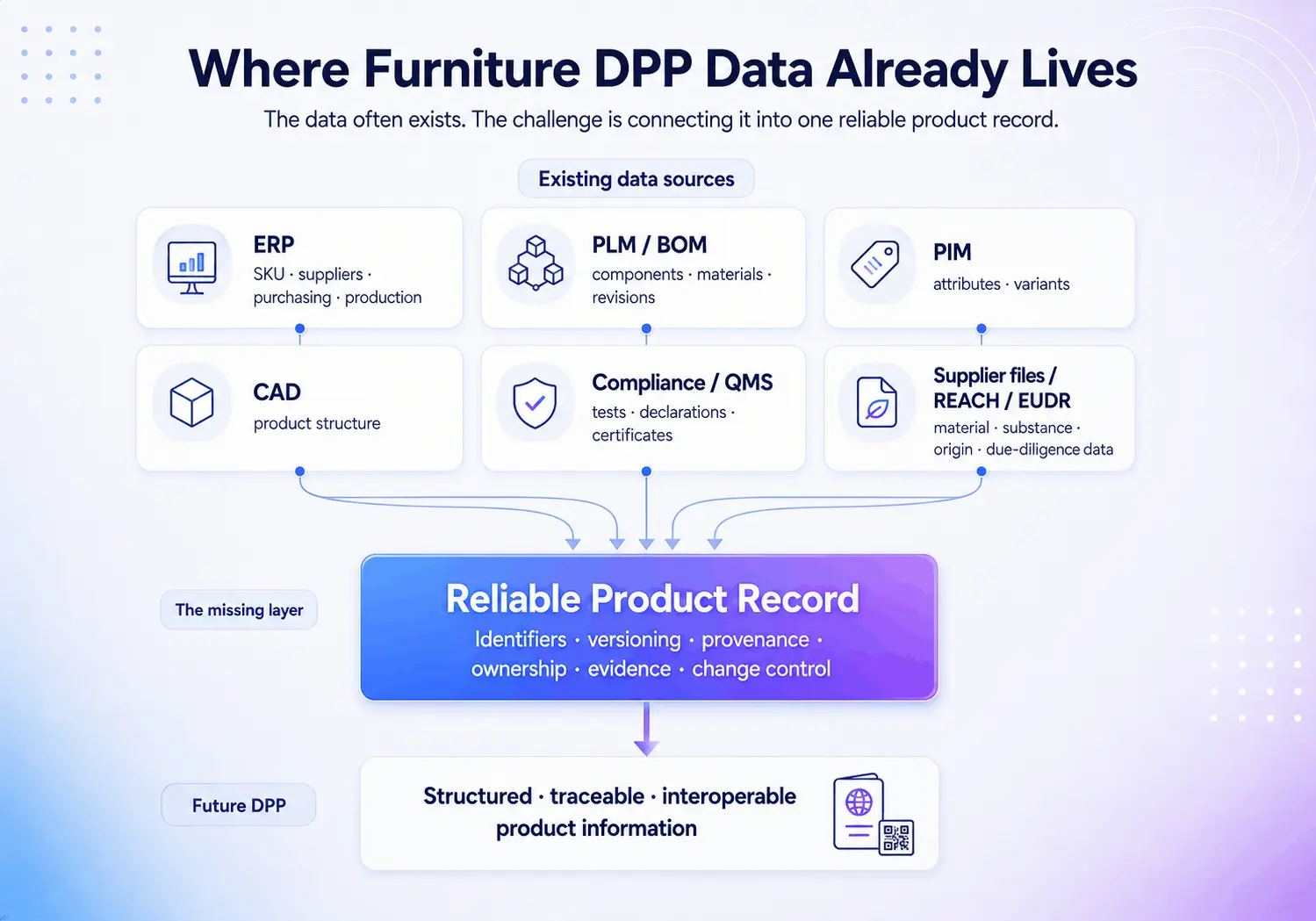
So the DPP challenge is not simply collecting more data. It is identifying which source is authoritative, how each data point links to evidence, and how those links stay accurate when the product changes.
Furniture rules are still open – the infrastructure is not
Furniture-specific requirements are still being written, but the DPP system they will plug into is already operational in key parts. The EU DPP Registry went live on 20 July 2026, providing the infrastructure for registering product identifiers and associated metadata.
The broader technical architecture is also becoming defined. Under the Ecodesign for Sustainable Products Regulation – Regulation (EU) 2024/1781, DPPs are built around unique identifiers, machine-readable data carriers, structured data and interoperability. In 2026, the Commission also moved forward with standards covering identifiers, interoperability, data carriers, APIs, data-exchange protocols and data storage through Commission Implementing Decision (EU) 2026/1736.
One distinction matters: the Registry is not a central EU database containing every product passport and all underlying product data. As the European Commission’s DPP overview explains, the architecture is decentralized. Detailed passport data can remain with the relevant economic operator or DPP service provider, while the Registry functions as an EU-level layer for identifiers and associated metadata.
For furniture manufacturers, this narrows the technical uncertainty. The final dataset, passport granularity and carrier requirements are still open, but the direction is already clear: future furniture data will need to be structured, identifiable, interoperable and accessible through systems – not stored only in documents or disconnected databases.
What furniture manufacturers can prepare now
Manufacturers do not need the final furniture DPP specification to start preparing. The useful work today is to make existing product data identifiable, traceable, structured and maintainable so it can later support the fields and passport level the EU eventually requires.
1. Start with one product family, not the whole catalogue
Choose a representative product – for example, an office chair family or a configurable sofa – and map everything that describes it today.
Identify where the SKU and model are created, where components and materials are recorded, where supplier information sits, where certificates and declarations are stored, and which system contains the current version of each attribute.
The output can be simple: data element → system → owner → format → supporting evidence → last update.
This quickly exposes duplicated fields, missing information and cases where nobody can say which system is authoritative.
2. Map the identifier hierarchy
Furniture businesses often have several identification layers: model → SKU → variant → configuration → batch → component
Make sure these relationships can be followed across ERP, PLM, PIM and other systems.
For configurable products this matters particularly. A sofa offered in 10 fabrics, five leg types and four sizes can create 200 commercial configurations. The EU has not yet decided whether the furniture passport will operate at model, batch or item level, so manufacturers should understand their identifier structure now without hard-coding the future passport granularity.
3. Audit what suppliers can actually provide
For the main materials and components, check what information is available from suppliers and in what form.
Can a supplier provide material composition, substance information, relevant certificates, origin information where applicable, recycled-content evidence or a stable component identifier? Is the information delivered through an API, spreadsheet, portal, PDF or email? Does it have an expiry date? Can it be linked to the exact component and product version that uses it?
This is not a secondary issue. In KPMG's cross-sector European DPP readiness survey, supplier engagement and data collection was already the most common preparation activity, reported by 47% of surveyed organizations. KPMG – European Digital Product Passport Readiness Survey 2026
4. Give critical data provenance and version history
A useful product-data record should be able to answer: value → source → supplier → evidence → validity → product version → owner
If a fabric supplier changes, the previous declaration should not simply be overwritten. The system should preserve which evidence applied to the previous version, when the change became effective and which products are affected.
The same principle applies to material specifications, compliance evidence, repair information and other data that may change during a product's life.
5. Move important facts out of PDF-only workflows
PDFs will still matter as evidence. The problem is when the PDF is the only place where an important product attribute exists.
For example, if a supplier declaration contains the material type, supplier identity, document validity and applicable component, those facts should also exist as structured fields that systems can search, validate and exchange. The original document can remain attached as supporting evidence.
This aligns with the wider ESPR architecture, which is built around machine-readable and interoperable product information rather than document repositories alone.
6. Build the data layer for change, not for today's guessed DPP schema
The furniture-specific dataset is still open. Architecture should therefore make it possible to add or change fields without redesigning the entire product-information stack.
That means identifying authoritative data sources, exposing governed information through APIs or other interoperable interfaces, separating the product-data layer from the eventual passport interface, and maintaining access control and versioning.
The objective is not to build “the final furniture DPP” in 2026. It is to make product information sufficiently structured and connected that the eventual requirements can be added without rebuilding the underlying systems.
A simple readiness test
Pick one real product family and try to reconstruct its current product record. Can you identify the exact model and configuration, trace each significant component to its supplier, see which version is currently used, find the supporting declarations and certificates, identify who owns each critical field, distinguish structured data from PDF-only information, and determine what would change if one supplier were replaced?
If that cannot be done reliably today, that is the preparation gap worth addressing now – regardless of which final furniture DPP fields the EU adopts in 2028.
Conclusion: Prepare the data foundation
Furniture manufacturers still do not have the final DPP specification. 2028 is the current target for adoption of the furniture delegated act, not the compliance deadline, and key details are still open.
What can be done now is more practical: clean up product data, connect supplier evidence, improve identifiers and versioning, and reduce dependence on PDF-only workflows.
How SmithySoft can help
SmithySoft can help manufacturers:
- audit product data across ERP, PLM/BOM, PIM and compliance systems;
- connect fragmented product and supplier data;
- build structured product records with identifiers, versioning and provenance;
- prepare APIs and integrations for future DPP platforms;
- pilot the approach on one product family.
The goal is not to guess the final passport. It is to make the data infrastructure ready for it.