
 Set as preferred source


The EU’s Digital Product Passport for steel is moving from concept to specification. In March 2026, the European Commission’s Joint Research Centre published a proposal detailing what information could be required in Digital Product Passports for intermediate steel products.
Product identifiers, producer and origin information, technical characteristics, recycled content and environmental performance are among the data categories now under consideration.
The timing makes this more than an early technical discussion. The European Commission currently targets Q4 2026 (October–December 2026) for adoption of the ESPR delegated act for iron and steel. That act is expected to determine the final scope and information requirements for the sector.
This article examines the proposed data requirements, what remains undecided, and the EU timeline toward the final rules.
Which iron and steel products are in scope?
The proposed Steel DPP is focused on intermediate iron and steel products – materials placed on the EU market for further processing rather than finished goods such as cars, machinery or appliances. This makes steel the first intermediate product group being addressed under the ESPR framework.
The European Commission’s Joint Research Centre preparatory study on iron and steel considers a broad range of intermediate products, including coils, sheets, plates, bars, sections, tubes, wire rod, railway material, cast steel and iron products, and stainless steel.
For the detailed assessment, five representative product groups were selected:
- Hot rolled coil
- Wire rod
- Cold rolled coil galvanised
- Electrical steel
- Stainless steel
An important distinction is that “finished” steel products are not necessarily finished products in the regulatory sense. A steel coil, for example, may have completed the steel production process but still be an intermediate input used to manufacture another product.
Vehicles, machinery, appliances and construction elements containing steel are downstream end-use products and are not what the current Steel DPP proposal is targeting.
These product groups give the clearest indication so far of where the Steel Digital Product Passport could apply. They come from the European Commission’s technical work supporting the future regulation, rather than from the final legal requirements. The next step is the delegated act for iron and steel, currently targeted for Q4 2026, which is expected to determine the final scope and requirements.
Who is affected?
DPP requirements may apply to manufacturers, producers, importers and other economic operators placing covered iron and steel products on the EU market.
Other actors, including recyclers, downstream operators and public authorities, may have access to relevant product information in line with the access rights defined in the delegated act.
What data is proposed for the iron and steel DPP?
In March 2026, the European Commission’s Joint Research Centre proposed what information could be included in Digital Product Passports for intermediate steel products.
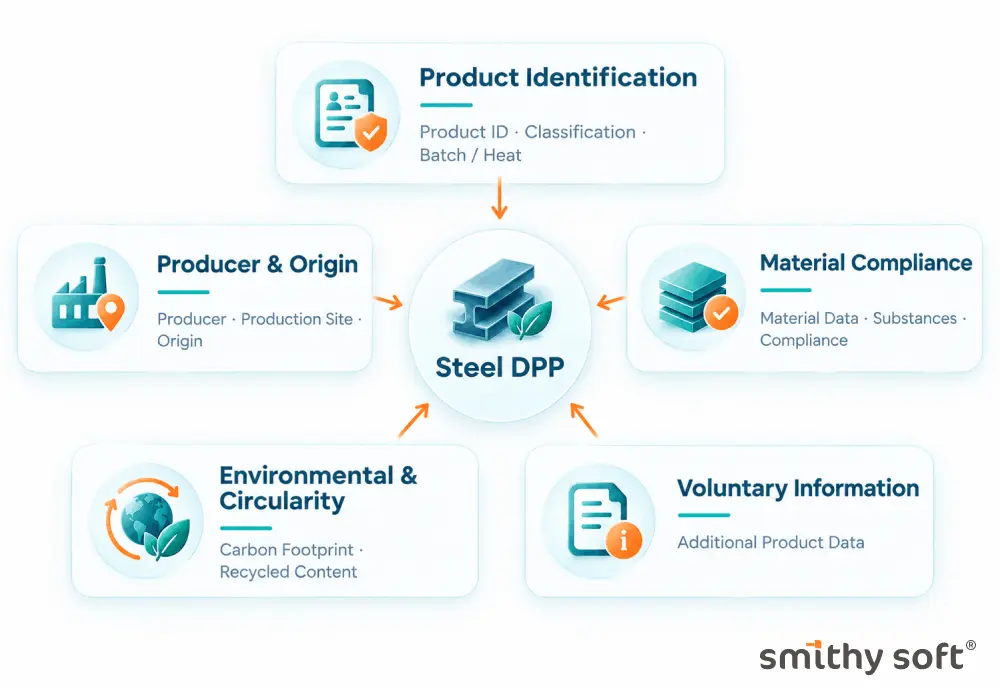
The proposal groups the information into five main areas:
1. Product identification and classification
Information used to identify the steel product and connect it to the relevant passport.
2. Producer identification and origin
Information identifying who produced the steel and where it originated.
3. Material compliance and substances of concern
Data related to material compliance and substances that may be subject to specific reporting requirements.
4. Product environmental and circularity information
This is one of the most substantial parts of the proposal. It covers environmental and circularity characteristics of the steel product, including recycled content and product carbon footprint.
5. Voluntary information
Additional information that could be included in the passport without being mandatory.
Importantly, these are proposed requirements, not the final mandatory dataset. The report itself describes the document as a draft proposal for stakeholder consultation that may be refined during the subsequent impact assessment
How would a steel product be identified?
One of the key questions is what exactly one Digital Product Passport would represent. For steel, the March 2026 proposal points primarily to identification at batch level, rather than requiring a separate passport for every individual piece of steel.
The proposal recommends using the heat number as the unique product identifier at batch level. A heat number already links steel produced from the same melt to its production and quality records, making it a practical starting point for Digital Product Passport traceability.
For some steel products, more detailed identification could also be used. The proposal considers a cast or lot number as an additional batch identifier and serial numbers for individual items where appropriate.
This distinction matters because the final EU rules have not yet determined whether different steel products will require passports at model, batch or individual-item level.
Recycled content and carbon footprint
Two environmental indicators stand out in the March 2026 proposal: product carbon footprint and recycled content. Both are identified as potential areas for future regulatory requirements for intermediate steel products.
For recycled content, the proposal includes the percentage of recycled material and a split between pre-consumer and post-consumer material. The proposed approach builds on ISO 14021 and existing industry practices.
For carbon footprint, the proposal includes a product carbon footprint declaration. The calculation methodology is still being developed, with the report pointing toward alignment with existing European emissions frameworks and interoperability with environmental declarations used for construction products.
A key issue is how precisely these values can be linked to an individual steel product or production batch. The proposal currently allows carbon footprint and recycled content to be reported at batch or model level, while the pre-consumer/post-consumer split is proposed at batch level. The report notes that the final granularity for recycled content cannot be determined until the methodology is finalised and validated through stakeholder consultation.
Where will the steel DPP data come from?
For many steel producers, the Digital Product Passport would not require creating all product data from scratch. The European Commission’s Joint Research Centre found that much of the relevant information is already generated through existing production, quality and compliance processes.
A key source is the Mill Test Certificate. It already contains technical and material information such as steel specifications, dimensions, chemical composition and mechanical properties. These certificates are generally created digitally, but exchange between companies still takes place predominantly through documents such as PDFs or non-standardised digital formats.
Other proposed passport information already exists in different forms. Material compliance data can come from supplier declarations and documentation used to demonstrate compliance with chemical substance rules. Carbon footprint information may already be calculated through Environmental Product Declarations or methodologies such as ISO 14067. Recycled-content reporting, however, is less mature: the report identifies limited current practice, inconsistent methodologies and gaps in upstream data availability.
This means the challenge is not simply collecting more data. The report identifies a broader gap: steel companies often have the underlying information, but structured and interoperable data exchange is not yet consistently implemented across the value chai
EU timeline: what happens next?
The European Commission adopted its Ecodesign for Sustainable Products and Energy Labelling Working Plan 2025–2030 in April 2025, identifying iron and steel as one of the first priority product groups.
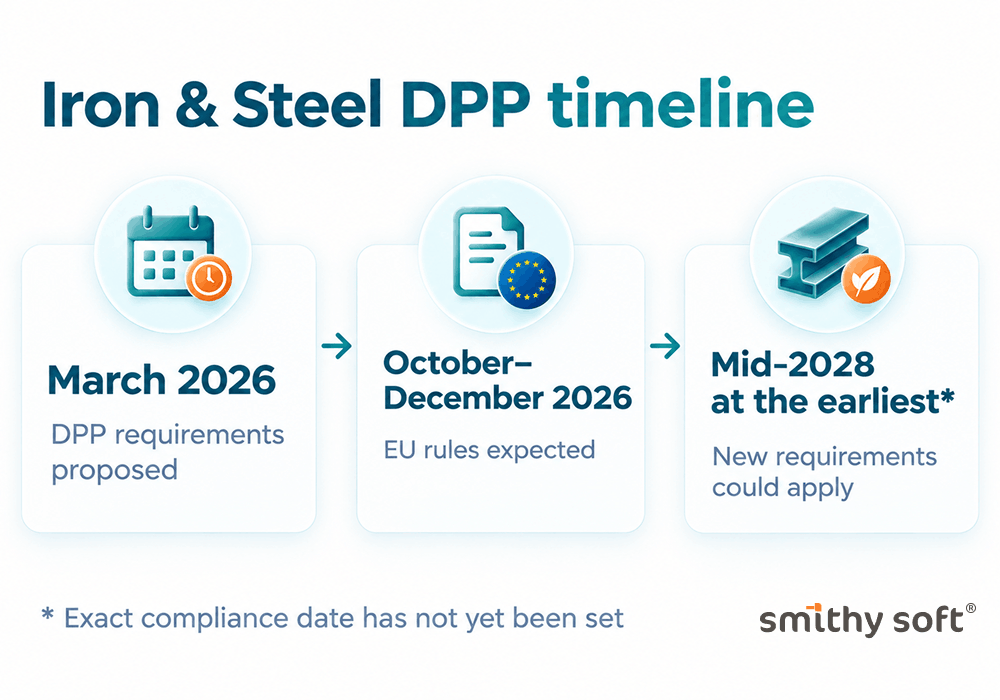
In March 2026, the European Commission’s Joint Research Centre published its proposed Digital Product Passport content for steel. The document is part of the technical work supporting the future requirements rather than the final regulation.
The next major milestone is Q4 2026 (October–December 2026), when the European Commission currently expects to adopt the delegated act setting specific requirements for iron and steel.
This will not mean that companies must comply immediately. Under the Ecodesign for Sustainable Products Regulation, the application date of a delegated act should generally be at least 18 months after it enters into force, unless an earlier application date is justified.
If the iron and steel delegated act enters into force around the end of 2026, this general rule would point to mid-2028 at the earliest for the new requirements to start applying. However, the exact compliance date has not yet been set and will depend on the final delegated act.
How to prepare for the Iron and Steel DPP
The March 2026 proposal provides enough detail for companies to start assessing their data readiness.
Map the required data. Identify where product identification, producer and origin information, material compliance, recycled content and carbon footprint data are currently stored.
Connect data to the product. Check whether this information can be consistently linked to the relevant heat, batch or individual steel product.
Review supplier data. Determine which proposed fields depend on information from upstream suppliers and where data is incomplete or provided only in documents.
Assess data formats. Identify information that still moves through PDFs, certificates or other non-standardised formats and would need to become structured and machine-readable.
Identify the gaps. Compare the proposed Digital Product Passport fields with the data currently available across production, quality, compliance and environmental processes.
The practical objective is not to build the passport first, but to make the underlying product data ready for it.
So, what this means for steel companies?
The Steel Digital Product Passport will require companies to connect information that today may be spread across production records, certificates, supplier documentation and environmental reporting.
The practical task is therefore clear: know which data belongs to each product or batch, where that data comes from, and whether it can move between systems in a structured format.
For many companies, the biggest gap may not be missing information, but disconnected information. Product identifiers, origin, material compliance, recycled content and carbon footprint data need to be linked to the same product record and made available across the supply chain.
This is where SmithySoft can help: integrating existing data sources, replacing document-based data exchange with structured workflows, and developing the software infrastructure needed to generate and manage Digital Product Passports.
The starting point is not the passport itself. It is making product data connected, structured and traceable.