
 Set as preferred source


The Ecodesign for Sustainable Products Regulation (ESPR) has been in force since July 2024 and provides the legal framework for future product-specific ecodesign and information requirements in the EU. It also establishes the Digital Product Passport (DPP) as part of that framework.
Textiles and apparel are among the priority product groups under the ESPR Working Plan 2025–2030. However, the detailed DPP requirements for apparel are still being developed. 2027 is an indicative regulatory milestone, not a confirmed compliance deadline.
This article looks at what is already confirmed, what remains open, and what is expected next. For a broader overview of DPP requirements, data and business implications, see our EU Digital Product Passport requirements for Textiles guide.
What is ESPR – and how does it relate to Textile DPP?
The Ecodesign for Sustainable Products Regulation (ESPR) is Regulation (EU) 2024/1781, in force since 18 July 2024. It creates the EU framework for setting ecodesign requirements for products and establishes the Digital Product Passport (DPP). Article 1 defines this scope.
ESPR does not set one finished set of requirements for all products. Under Article 4, the European Commission adopts delegated acts for specific product groups. These acts determine the applicable ecodesign and information requirements.
For DPP specifically, Article 9 states that where a product-specific delegated act requires a Digital Product Passport, the product can only be placed on the EU market if that passport is available in accordance with the applicable rules. The actual DPP data and product-specific obligations therefore depend on those delegated acts.
For textiles, the regulatory path is:
ESPR Regulation (EU) 2024/1781 → ESPR Working Plan 2025–2030 → textile/apparel-specific delegated act → applicable DPP requirements.
Textiles are explicitly identified among the priority product groups in Article 18 of ESPR, while the Working Plan places Textiles/Apparel among the first groups for product-specific rulemaking. The delegated act containing the final apparel requirements has not yet been adopted.
Why Textiles and Apparel are an ESPR priority
Textiles were prioritised directly in Article 18(5)(c) of Regulation (EU) 2024/1781, which requires the first ESPR Working Plan to prioritise “textiles, in particular garments and footwear.”
The ESPR Working Plan 2025–2030 places Textiles/Apparel first among the final-product priorities and gives 2027 as the estimated timeline for setting the relevant ecodesign requirements.
The Commission points to the sector’s potential for longer product lifetimes, better material efficiency, and lower impacts from water use, waste generation, climate change and energy consumption. It also expects ESPR information requirements to work alongside the EU Textile Labelling Regulation.
Importantly, being listed as an ESPR priority does not mean that Textile DPP requirements already apply. It means that the European Commission is developing product-specific rules for textiles and apparel. The binding requirements – including the final DPP obligations and application date – will be defined in a future delegated act.
The ESPR Working Plan currently points to 2027 for adoption of the textile/apparel measure, while JRC planning materials indicate early 2027 as the expected timing. This remains an indicative timeline rather than a legally fixed deadline.
What is confirmed – and what is still open
The regulatory picture is now clearer than it was a year ago. ESPR already establishes the core Digital Product Passport framework, and textiles/apparel are formally included among the priority product groups. What remains unresolved is how those general rules will translate into binding, product-specific obligations for textile apparel.
| Area | Already established | Still to be defined for textile/apparel |
|---|---|---|
| Legal framework | Regulation (EU) 2024/1781 (ESPR) is in force and establishes the framework for product-specific ecodesign and information requirements. | The textile/apparel-specific delegated act has not yet been adopted. (EUR-Lex) |
| Digital Product Passport | Articles 9–11 establish the core DPP framework. DPP data must be accurate, complete and up to date, and the passport must meet general requirements for identification, interoperability and accessibility. | The apparel delegated act will determine how these requirements apply specifically to textile apparel products. (EUR-Lex) |
| Textiles/apparel priority | Textiles/Apparel are a priority final-product group in the ESPR Working Plan 2025–2030, with 2027 indicated as the expected timing for adoption of the measure. | The final product scope covered by that measure has not yet been legally fixed. (Environment) |
| DPP data | ESPR Annex III already defines the categories of information from which product-specific DPP data can be selected. | The exact mandatory data fields for textile apparel are not final. The May 2026 JRC study proposes a dataset, but it remains preparatory and subject to validation and impact assessment. (EUR-Lex) |
| Product-specific DPP setup | ESPR already requires, among other things, a persistent unique product identifier, a data carrier, open standards and interoperable data formats. | The delegated act must still specify matters such as the data carrier to use, its positioning, whether the DPP operates at model/batch/item level, specific access rights, who can create or update data, and how long the DPP must remain available. (EUR-Lex) |
| DPP Registry | Commission Implementing Regulation (EU) 2026/1778, in force since 6 August 2026, now sets implementation arrangements for the EU DPP Registry, including registration, APIs, verification and the semantic repository. | Product-specific data models will still depend on the relevant delegated acts. (EUR-Lex) |
| Timeline | 2027 is the current indicative timing for adoption of the Textiles/Apparel measure. ESPR also provides, as a general rule, that a delegated act should not apply earlier than 18 months after its entry into force. | The actual textile/apparel application date has not yet been set. The 18-month rule can also have justified exceptions, so it should not be converted into a fixed 2028/2029 deadline yet. (Environment) |
The practical distinction is therefore between framework readiness and product-specific compliance. Companies can already work against established DPP principles and improve the quality, structure and accessibility of their product data, but the final apparel scope, mandatory data set and application date will depend on the forthcoming delegated act.
ESPR and Textile DPP timeline: 2024–2029
The regulatory path for Textile DPP is already underway, but several stages still separate the ESPR framework from binding apparel-specific requirements. The timeline below distinguishes confirmed milestones from indicative dates.
| Year | Milestone | What it means |
|---|---|---|
| 2024 | ESPR enters into force | Regulation (EU) 2024/1781 entered into force on 18 July 2024, establishing the legal framework for product-specific ecodesign requirements and Digital Product Passports. |
| 2025 | Textiles/Apparel prioritised | The ESPR Working Plan 2025–2030 placed Textiles/Apparel first among its priority final-product groups and indicated 2027 for adoption of the relevant measure. |
| 2026 | Preparatory work continues | JRC is developing the proposed DPP content for textile apparel products as part of the preparatory study supporting the future delegated act. The proposals still require stakeholder validation and further assessment. |
| 2027 | Indicative adoption of the Textile/Apparel measure | The Working Plan and current JRC material point to 2027 as the tentative year for the future delegated act introducing product-specific requirements for textile apparel. The date remains indicative. |
| 2028–2029 | Potential transition and application period | ESPR generally requires delegated acts to provide at least 18 months between entry into force and application, except in duly justified cases. If the textile/apparel measure is adopted in 2027 and the standard period applies, requirements could begin applying later – but no final Textile DPP application date has yet been set. |
2027 is not the Textile DPP compliance deadline. It is currently the indicative timing for adoption of the product-specific measure. The binding application date will only become clear once the delegated act is adopted.
The sequence is therefore ESPR framework → product-specific delegated act → transition period → application. For businesses, this leaves a preparation window, but not yet a fixed deadline against which a complete Textile DPP implementation can be planned.
What companies can prepare now
The final Textile DPP specification is still being developed, but companies do not need to wait for the delegated act to improve the foundations that any future implementation will depend on.
The most useful preparation now is to:
- Map product data – identify where material composition, supplier, sustainability and product information is currently stored.
- Review source systems – understand how ERP, PIM, PLM and supplier platforms exchange product data.
- Identify data gaps – flag information that is missing, inconsistent, unstructured or dependent on suppliers.
- Review product identifiers – check whether products, models and SKUs can be consistently matched across systems.
- Define data ownership – establish who is responsible for creating, validating and updating each type of product information.
At the same time, companies should avoid designing their systems around assumptions that are not yet legally fixed, including the final mandatory data fields, exact DPP schema, product scope and application date.
The practical priority is therefore data readiness and system interoperability, not premature compliance implementation.
What this means for Fashion companies
For fashion brands, manufacturers and retailers, the main task is not to build a final DPP solution before the rules are complete. It is to understand whether existing product data and systems will be able to support the requirements once they become binding.
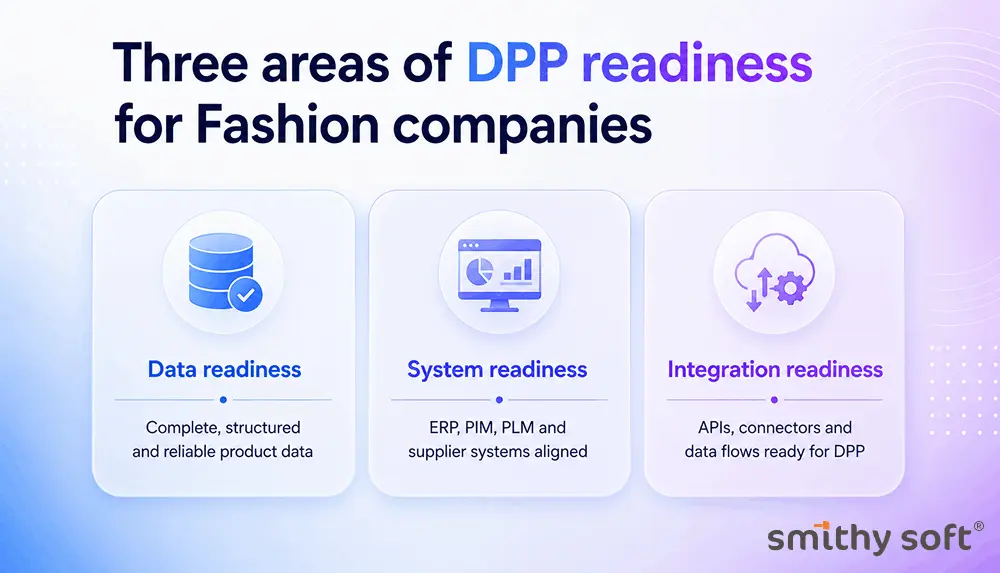
This approach reduces the risk of investing too early in a fixed DPP implementation while addressing the data and integration problems that are likely to remain relevant regardless of the final specification.
How SmithySoft can help
SmithySoft can help fashion companies assess and prepare the technical foundation for Textile DPP without assuming that the final regulatory specification is already fixed.
This can include:
- Product data and system audits to identify gaps across ERP, PIM, PLM and supplier systems.
- Integration architecture for connecting existing platforms and consolidating product information.
- Supplier data integration where required information comes from external manufacturers or supply-chain partners.
- DPP architecture and prototypes to test how product data, identifiers and customer-facing access could work before committing to a full implementation.
- Legacy system modernisation where existing infrastructure cannot reliably support new product-data requirements.
The objective is not to build around requirements that may still change, but to make the underlying data and systems adaptable enough to support the final Textile DPP rules when they are adopted.