
 Set as preferred source


It is already clear that textiles are among the first product groups the EU is targeting for requirements under the Ecodesign for Sustainable Products Regulation, including the Digital Product Passport. We have already covered what the Textile DPP could require and which rules are confirmed and what is still being developed.
The next question is more practical: where will the data inside a Textile Digital Product Passport actually come from?
For a garment, that data is created long before the finished product reaches a brand. It accumulates as fiber becomes yarn, yarn becomes fabric, fabric is dyed and finished, and different materials are assembled into the final product.
Fiber → Yarn → Fabric → Dyeing & Finishing → Garment → Brand → Digital Product Passport
At each stage, new data is created and existing data needs to remain connected to the material. If that connection is lost somewhere in the supply chain, the information available for the final Digital Product Passport becomes incomplete.
This article follows that data journey: where textile product data originates, who holds it, how it moves between suppliers, and where traceability can break.
Where Textile DPP data comes from
According to the European Commission, Textile DPP data may include product identification, fibre composition, origin, economic operators, and compliance information.
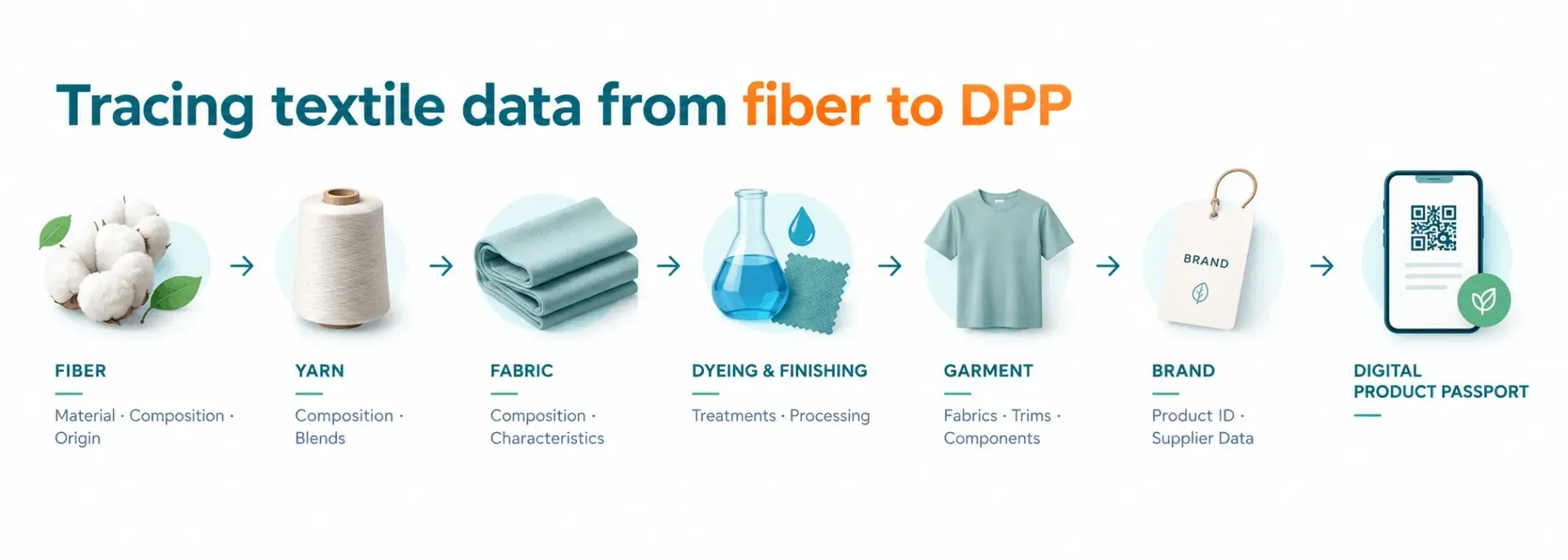
The result is not six separate passports. The relevant information from these stages must ultimately be connected to the finished product and its identifier: Fiber → Yarn → Fabric → Dyeing & Finishing → Garment → Brand → Digital Product Passport
This is where traceability becomes critical: the brand may publish the final Digital Product Passport, but much of the data needed to support it originates upstream and has to remain connected to the product as it moves through the supply chain.
Who holds the data along the textile supply chain?
No single company necessarily holds all the information that may ultimately support a Textile Digital Product Passport. The European Commission explicitly notes that suppliers and service providers may be required to provide relevant information available to them, while responsibility for compiling the DPP rests with the economic operator placing the product on the EU market.
| Stage | Main data source | Information generated or passed forward |
|---|---|---|
| Fiber | Fiber producer / supplier | Fibre type, composition and relevant origin information |
| Yarn | Spinner / yarn producer | Fibre inputs, blends and yarn characteristics |
| Fabric | Weaver / knitter / textile producer | Yarn inputs, composition and fabric characteristics |
| Dyeing & finishing | Processor | Information related to treatments, chemicals and processing |
| Garment | Garment manufacturer | Materials and components assembled into the finished product |
| Brand / economic operator | Brand, manufacturer or importer | Compiles relevant product and supplier information for the finished product |
The data may already exist across the supply chain. The challenge is keeping it connected as materials move between suppliers and are transformed into the finished product.
Where textile traceability breaks
Textile traceability becomes difficult when information exists but can no longer be reliably connected to the material or product it describes. The European Commission’s preparatory work highlights the complexity of textile supply chains, where materials pass through multiple production and processing stages before becoming a finished product.
The main breaks can occur when:
- Materials are mixed. Fibres from different sources can be combined into yarn, and different yarns into fabric. The link between an upstream source and the resulting material therefore needs to survive each transformation.
- Identifiers change between stages. Suppliers may identify materials, batches and products differently. Without a reliable link between these identifiers, records from one production stage may not follow the material into the next.
- Supplier information is fragmented. Relevant information can be distributed across certificates, technical documentation, compliance records and supplier data rather than maintained as one continuous product record.
- Processing adds new information. Dyeing, finishing and other treatments can change the characteristics of the material and introduce additional chemical or processing information that must be associated with the correct material.
- Visibility stops upstream. A garment manufacturer or brand may have information from its direct supplier without automatically having the same visibility into earlier stages of the supply chain.
The result is a simple but important distinction: having the data is not the same as having traceable data. For a Digital Product Passport, relevant information must remain connected to the correct material as it is transformed and ultimately to the finished product.
Having the data is not the same as having traceable data. A certificate, supplier record or material specification becomes useful for DPP traceability only when it can be reliably connected to the relevant product.
How to maintain data continuity from material to finished product
The EU framework establishes several principles for Digital Product Passport traceability. A DPP must be connected to a persistent unique product identifier, while the data must refer to the relevant product model, batch or individual item. DPP data must also use open standards and interoperable formats and, where appropriate, be structured, machine-readable, searchable and transferable.
For a textile supply chain, the practical challenge is to preserve the links between records as materials are transformed:
Supplier → Material / Batch → Processing → Component → Finished Product → Product Identifier
The objective is not to put every supplier record into one database. It is to preserve the relationships between them, so relevant upstream information can still be traced to the correct finished product.
In practice, this means three things:
- Identify the product correctly. The final DPP needs to correspond to the correct model, batch or item, as eventually specified by the textile delegated act.
- Preserve input-to-output links. When yarn becomes fabric or fabric becomes a garment, the records should retain which inputs were used for which outputs.
- Exchange usable data. Relevant information needs to move between suppliers and systems in a structured form rather than remain disconnected across documents.
This reflects the purpose of the ESPR framework: DPP requirements are explicitly intended to improve product traceability along the value chain.
Textile traceability in practice
Consider a cotton T-shirt. Its Digital Product Passport may ultimately identify the finished product at model, batch or item level – the exact level for textiles will be determined by the future delegated act. The supporting information, however, can originate much earlier in production. The Commission currently plans adoption of the textile delegated act for Q4 2027.
Suppose a fiber supplier delivers cotton under Lot C-1842. A spinner uses that cotton to produce Yarn Batch Y-527 and records which fiber lot went into the batch.
The yarn is then used by a fabric mill to produce Fabric Batch F-310. After dyeing and finishing, the processing information is associated with that fabric batch. Finally, the garment manufacturer uses the processed fabric, together with thread, labels and other components, to produce the T-shirt.
The traceability chain could look like this: Fiber Lot C-1842 → Yarn Batch Y-527 → Fabric Batch F-310 → Dyeing & Finishing Record P-088 → T-Shirt / Finished Product → Product Identifier → Digital Product Passport
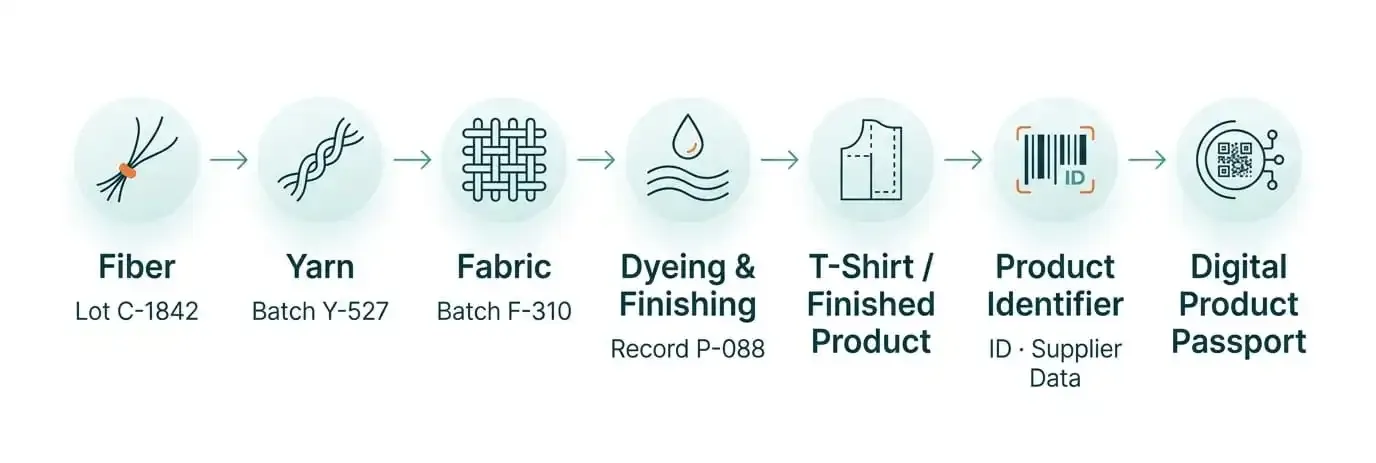
The practical requirement is to preserve the input-to-output relationship at every transformation. When Yarn Batch Y-527 becomes Fabric Batch F-310, the fabric manufacturer records which yarn batch was used. When that fabric becomes a garment, the manufacturing record preserves the link to the relevant fabric batch.
If one of those links disappears, the information may still exist, but its provenance becomes harder to establish. A brand could hold a cotton certificate and a fabric specification without being able to reliably demonstrate that both relate to the T-shirt being sold.
That is the difference between collecting supplier data and maintaining traceability. The relevant upstream information needs to remain connected through the production chain so it can ultimately be associated with the correct finished product.
*Lot, batch and processing identifiers in this example are illustrative. They are not proposed EU identifiers for these textile production stages. The future textile delegated act will determine the required DPP data and whether the passport applies at model, batch or item level.
What companies can do now
Companies do not need to wait for the final textile-specific DPP requirements to test whether their supply-chain data is traceable. A practical starting point is to select one real product and trace its data backwards.
Start with the finished garment and ask:
- Can the product be linked to the fabric used?
- Can the fabric be linked to relevant production and processing records?
- Can supplier information supporting composition, origin and other product data be traced back to the correct material?
- Where does this information currently exist – internal systems, supplier files, certificates or spreadsheets?
- At what point does the connection between the product and its upstream data become unclear?
The result is a simple traceability map. It shows not only what information the company already has, but where relationships between records are missing.
Those gaps are likely to matter more than the number of documents already collected. A company may have extensive supplier documentation and still be unable to connect a specific material record to the product it ultimately sells.
The first step toward Textile DPP readiness is therefore not necessarily building the passport itself. It is determining whether the data behind one real product can already be traced through the supply chain.
Conclusion
Textile DPP readiness depends on one core capability: keeping product data connected across the supply chain.
SmithySoft can help companies audit existing data flows, identify traceability gaps, integrate ERP, PIM, PLM and supplier data, and build the technical infrastructure needed for DPP implementation.
The goal is practical: turn fragmented product data into a traceable, structured data flow connected to the finished product.