 Set as preferred source


2027 could mark a turning point for Digital Product Passports in the textile and fashion industries. The European Commission plans to adopt textile-specific requirements in Q4 2027, bringing greater clarity to how product information must be managed and shared.
For manufacturers and fashion brands, the technology decision goes beyond a simple choice between building or buying a DPP platform. There is a third option: combining ready-made software with custom integrations.
Each approach carries different implications for cost, flexibility, data control and long-term maintenance. As explored in our previous article on integrating Textile DPP with ERP, PIM and PLM, much of the relevant data may already exist within current systems.
So which approach makes sense, and under what conditions? This article examines the trade-offs between building, buying and adopting a hybrid DPP solution.
Three approaches to Textile DPP
There are three main ways to implement a Digital Product Passport solution. They differ in how much software a company develops itself, what it purchases from a provider and who is responsible for maintaining it.
1. Build: develop a custom DPP solution
A company develops its own software to manage product information, generate digital passports and control access to data.
This approach provides greater control over functionality, integrations and future changes. It can suit manufacturers or fashion groups with complex product structures, specialized processes or existing development capabilities.
However, the company also takes responsibility for development costs, security, maintenance and adapting the solution as EU requirements evolve.
2. Buy: use a ready-made DPP platform
A company subscribes to or purchases an existing DPP platform that provides passport creation, data management and publication features.
This can reduce the amount of software development required and simplify initial implementation. It is particularly relevant when the platform supports the company's product data and existing business systems.
The trade-offs include licensing fees, limitations on customization and dependence on the provider for updates, integrations and continued access to the service.
3. Hybrid: combine a DPP platform with custom components
A company uses an existing DPP platform while developing the integrations or additional functionality needed for its operations.
For example, the platform may manage digital passports, while custom software connects ERP, PIM, PLM and supplier records or applies company-specific data validation rules.
This approach allows businesses to reuse established software without abandoning their existing infrastructure. However, they must maintain both the platform relationship and the custom components.
The distinction is not simply between developing software and purchasing it. It is about deciding which capabilities to own, which to obtain from a provider and how much long-term responsibility to retain.
Build vs Buy vs Hybrid: what actually changes?
The three approaches differ not only in implementation effort but also in who controls the technology, maintains integrations and pays for future changes.
| Factor | Build | Buy | Hybrid |
|---|---|---|---|
| Initial costs | Custom development, infrastructure and testing | Platform setup, licensing and configuration | Platform fees plus custom integration costs |
| Time to launch | Depends on development scope and available resources | Can be shorter if standard features meet requirements | Depends on platform readiness and integration complexity |
| Flexibility | Functionality can be designed around specific business needs | Limited by available features and customization options | Standard features with custom extensions where needed |
| Integrations | Developed and maintained by the company or its technology partner | Depend on available APIs and connectors | Custom connections to existing systems |
| Data control | Greater control over storage, access and data architecture | Governed by platform capabilities and contractual terms | Shared between the platform and connected systems |
| Scalability | Must be designed, tested and maintained | Depends on provider capacity, pricing and service limits | Depends on both the platform and custom components |
| Maintenance | Company or development partner manages updates and security | Provider maintains the platform; company manages its data and configuration | Responsibilities are divided between provider and development team |
| Vendor dependence | Depends on hosting, technology and development partners | Greater dependence on the DPP platform provider | Dependence on both the platform and custom integrations |
A lower initial cost does not necessarily mean a lower total cost. Licensing, integration changes, data migration, maintenance and future regulatory updates can affect the economics of each approach.
Companies should compare the full cost of ownership over several years, not just the cost of launching their first digital passports.
What should determine your choice?
The right DPP solution depends less on company size than on existing infrastructure, product complexity and the resources available to maintain it.
5 factors deserve attention before selecting an approach.
1. Existing IT infrastructure
Companies with established ERP, PIM and PLM systems should first assess what these systems can already provide. If product data is accessible through APIs, a ready-made DPP platform or hybrid solution may be sufficient. Highly customized environments may require additional development.
2. Product and supplier complexity
A fashion brand managing a limited product range and a few suppliers has different requirements from a manufacturer operating across multiple factories, collections and sourcing networks. More complex data relationships may justify custom integrations or functionality.
3. Data quality and availability
No platform can automatically resolve missing material information, inconsistent product identifiers or incomplete supplier records. As discussed in Textile Supply Chain Traceability: From Fiber to Digital Product Passport, collecting reliable information across the supply chain is a prerequisite for meaningful product traceability.
4. Internal technical resources
Custom development requires ongoing responsibility for security, maintenance and software updates. Companies without dedicated technical capacity may prefer a managed platform, provided its capabilities meet their needs.
5. Regulatory flexibility
Textile-specific DPP requirements are still being developed. Companies should evaluate how easily a solution can accommodate changes to data fields, identification rules and access permissions without extensive redevelopment.
The most suitable approach is the one that meets current operational needs while keeping future integration, maintenance and regulatory adaptation manageable.
Practical examples: when to build, buy or go hybrid
Three hypothetical scenarios illustrate how textile manufacturers and fashion brands can choose different DPP solutions based on their existing systems and operational needs.
Buy: a fashion brand with standard product data
A fashion brand manages several clothing collections, works with a limited number of suppliers and stores product information in a PIM system.
Its main requirement is to publish digital passports using existing product descriptions, material specifications and supporting documents.
A ready-made DPP platform is a reasonable choice if it supports the required information, connects to the PIM system and provides suitable data export options.
The brand avoids developing its own passport software and can focus on maintaining accurate product records.
Hybrid: a manufacturer with multiple connected systems
A clothing manufacturer operates several production facilities and manages product specifications in PLM, manufacturing records in ERP and commercial information in PIM.
A ready-made DPP platform can manage passport publication, but the manufacturer needs additional software to connect production batches, material specifications and supplier documentation.
A hybrid approach combines the DPP platform with custom integrations. The manufacturer retains its existing systems while developing the connections and validation rules that standard software cannot provide.
Build: a fashion group with specialized requirements
An international fashion group operates several brands with different product structures, supplier networks and internal data systems.
Available DPP platforms have been evaluated but cannot accommodate essential requirements for data management, access control or integration without substantial modifications.
A custom-built solution becomes a viable option if the group has the technical resources and a clear business case for owning the platform.
The group gains control over its architecture and functionality but also assumes responsibility for security, maintenance and adapting the software to future requirements.
What these examples show
Company size alone does not determine the right approach. A large manufacturer may use a ready-made platform, while a smaller business with specialized requirements may need custom development.
The choice depends on how much existing software can be reused, what additional functionality is required and who will maintain the solution over time.
What to check before choosing a DPP vendor
A DPP platform may offer passport generation, QR codes and product data management. Before committing to a provider, textile manufacturers and fashion brands should establish how the solution will work with their existing infrastructure.
- Can it connect to existing systems?
Check whether the platform supports APIs or connectors for your ERP, PIM, PLM and supplier systems. Ask which integrations are included and which require additional development.
- Who controls the product data?
Confirm where information is stored, who can access it and whether the company can export its records in a usable, structured format.
- How are product changes handled?
Ask how the platform manages updated material specifications, supplier information and product versions without overwriting historical records.
- What happens when EU requirements change?
Textile-specific DPP requirements are still being developed. Our overview of ESPR and Textile DPP: what’s confirmed and what’s next explains the regulatory context and remaining uncertainties. Ask providers how they plan to accommodate future requirements and whether updates are included in their service.
- What is the full cost of ownership?
Compare more than subscription fees. Include setup, integrations, data migration, additional product volumes, support and potential exit costs.
- Can the company switch providers?
Check data export options, contract termination conditions and whether product identifiers and passport links can remain usable after migration.
A product demonstration can confirm available features. A limited pilot using real product records is more useful for testing integration capabilities, data quality and operational limitations before signing a long-term agreement.
Who does what in a Textile DPP project?
Implementing a Textile Digital Product Passport involves more than selecting software. Product information comes from different departments and suppliers, while technical implementation may involve several external partners.
Clear responsibilities are essential, regardless of whether a company chooses to build, buy or combine DPP technologies.
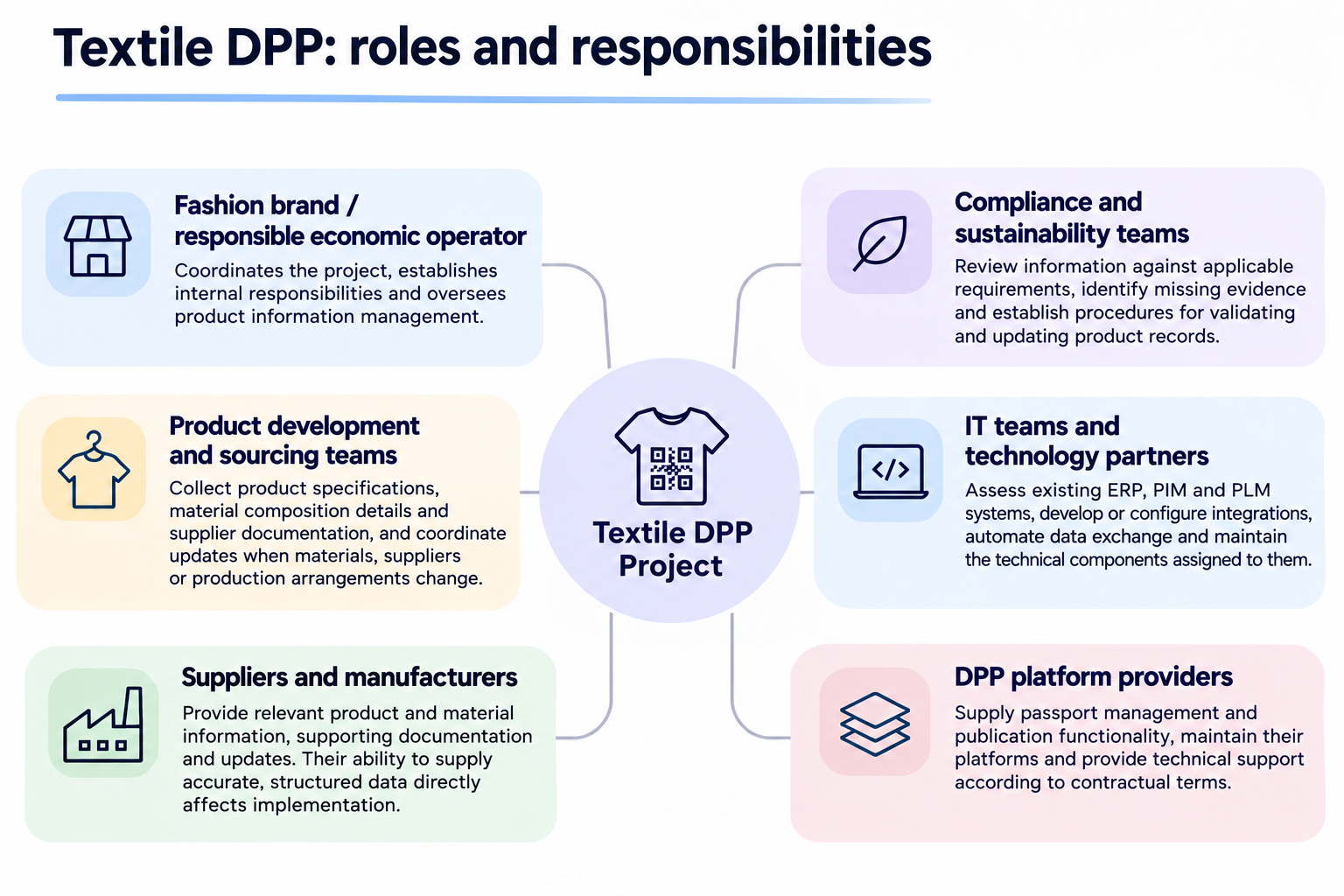
How responsibilities change between build, buy and hybrid
The business remains responsible for organizing its product data and compliance processes, but technical responsibilities differ:
Build: An internal development team or external technology partner develops and maintains the custom DPP solution.
Buy: The platform provider maintains the core software, while the brand manages its product data, internal processes and any integrations outside the provider's scope.
Hybrid: The platform provider maintains the standard DPP functionality, while an internal team or technology partner develops and supports custom integrations.
For smaller brands, several responsibilities may be handled by the same person or outsourced. Larger organizations may distribute them across dedicated teams.
Before implementation begins, appoint one internal project owner and document who is responsible for data collection, validation, system integration, passport publication and ongoing updates. This helps prevent gaps between business teams, suppliers and technology providers.
Before you invest: practical advice for fashion brands
Before purchasing a DPP platform or commissioning custom development, fashion brands should validate their data, workflows and operational requirements.
1. Start with a representative product category.
Choose a collection or product category that reflects your typical sourcing and production processes. Review the current regulatory framework outlined in EU Digital Product Passport Requirements for Textiles, then identify what product information is already available, what is missing and where it is stored.
2. Integrate DPP into collection development.
Determine when product information becomes available during design, sourcing and manufacturing. Plan how records will be collected and updated throughout these stages rather than assembled immediately before launch.
3. Include suppliers with limited digital capabilities.
Not every supplier uses compatible software. Evaluate whether the solution supports structured file uploads, document collection or simple data submission methods without requiring suppliers to implement new systems.
4. Audit existing systems before replacing them.
Review what your ERP, PIM and PLM systems can already support. Some DPP requirements may be addressed through integrations rather than purchasing additional software or rebuilding existing functionality.
5. Test scalability beyond the first collection.
Consider how the solution will accommodate additional product categories, seasonal collections, suppliers and markets. Check whether growing data volumes introduce new fees, manual work or integration limitations.
6. Calculate the full operating cost.
Include licensing or development, integrations, supplier onboarding, staff time, maintenance and future updates. Compare costs over several years rather than relying on initial implementation estimates.
7. Run a pilot with real product data.
Test the preferred approach using actual product records, supplier documentation and existing systems. Assess how much effort is required to collect, validate, publish and update information.
A successful pilot should demonstrate more than the ability to generate a digital passport. It should confirm that the process can be maintained across collections and suppliers without disproportionate operational costs.
How SmithySoft can help
Choosing between Build, Buy and Hybrid starts with understanding what your existing systems can support and where additional development is needed.
SmithySoft helps fashion brands and textile manufacturers assess their software infrastructure, identify integration requirements and implement solutions that fit their business processes.
Our relevant services include:
- Software Audit – evaluate existing ERP, PIM, PLM and other systems to identify technical limitations, integration opportunities and potential development needs.
- Custom Software Development – build custom applications, develop integrations and automate data exchange between existing systems and third-party platforms.
Whether you are considering a ready-made DPP platform, a hybrid approach or a fully custom solution, we can help assess the technical options and define a practical implementation scope.
Planning your Textile DPP implementation? Contact SmithySoft to discuss your existing systems and development requirements!